
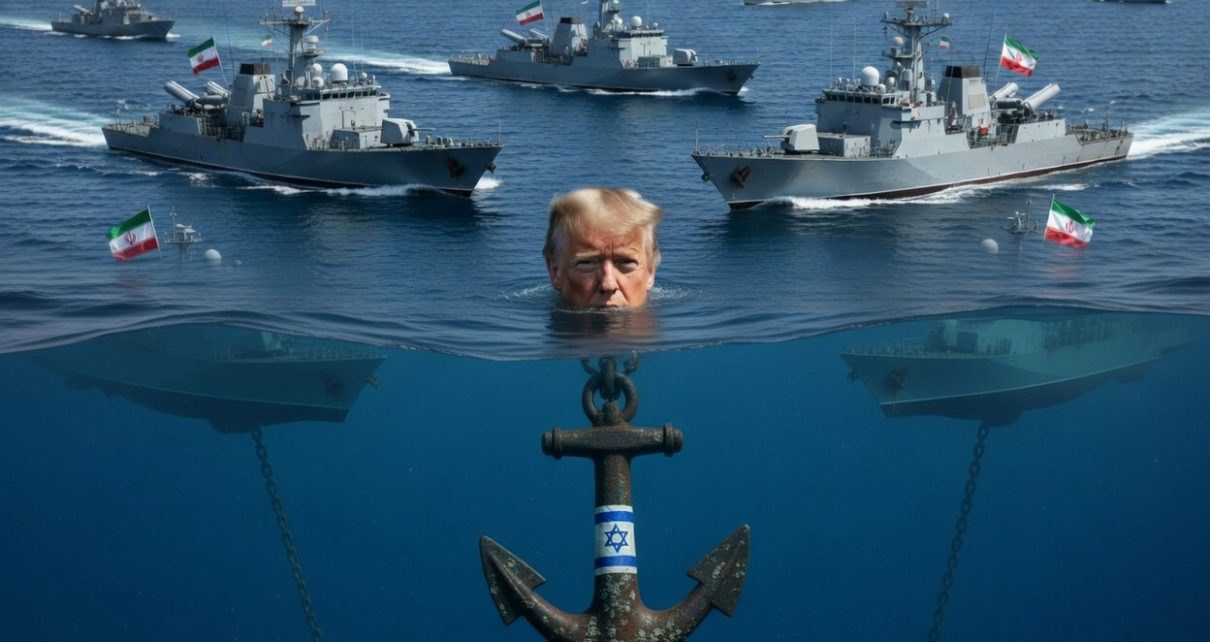
US President Donald Trump appears to be continually backtracking and/or contradicting himself on his various announcements regarding Iran. While his rhetoric attempts to project dominance, the administration’s actions reflect a state of crisis and suggest that it is being forced to back down.
After issuing a 48-hour ultimatum to the Islamic Republic of Iran—demanding that it reopen the Strait of Hormuz or face strikes on its energy infrastructure (despite the strait only ever being restricted to the US, Israel, and their co-belligerents)—Trump appeared to be backing down on Monday. Suddenly, the president began claiming that he was conducting negotiations with a defector from Tehran and that a “deal” was within reach in five days. He even stated that Tehran had agreed to concessions that would “reopen” the Persian Gulf.
Iran’s Foreign Ministry spokesperson, Esmaeil Baghaei, quickly rejected the US leader’s claims, asserting that no negotiations had taken place and that “Iran’s position regarding the Strait of Hormuz and conditions to end the imposed war has not changed.” Iranian officials then began offering their analysis that the White House’s change in tone was a deception aimed at making a retreat from Trump’s threats to attack Iran’s electrical infrastructure, while preparing for a possible ground offensive involving boots on the ground.
This aligns with facts on the ground that Western corporate media have failed to highlight. Not only were 2500 Marines sent on their way to the Persian Gulf, but estimates suggest that up to 5000 could arrive in the region by Friday. A frequently discussed target of any ground operation has been Iran’s Kharg Island.
In terms of attacks on Iran’s civilian energy sector, basic statistical analysis shows what a dangerous gamble such a move would be for the United States and its regional allies. Tehran responded immediately to Trump’s 48-hour deadline threat by publicizing part of its own target list and threatening a devastating retaliation.
Power plants are difficult to destroy and would require multiple waves of concentrated attacks to take offline. Iran has over 400 power plants in total, including some 150 major ones. Its largest site, the Damavand Combined Cycle Power Plant, supplies only 3.7-4% of the country’s total electricity needs. Even if the US and Israel managed to destroy it—which would demand significant firepower, given that Tehran’s infrastructure is hardened for war—the Iranian retaliation would follow.
By comparison, Israel only has five major power stations. Its largest, the Orot Rabin plant in Hadera provides roughly 20% of Israel’s total power needs; taking it out would cause a far greater catastrophe. The Gulf states also have a much smaller number of power plants. Bahrain, for example, relies on only a few, and these countries consume around five times more electricity per capita than Iran.
In other words, Iran is far less vulnerable than US allies to attacks on energy infrastructure. In addition to threatening retaliation against power plants on the other side, the Islamic Republic also warned that it could target water desalination facilities. Again, Iran relies on desalination facilities for only a tiny fraction of its water needs (low single digits), while Gulf states like Qatar and Kuwait depend on it for 90% or more of their needs.
The Strait Of Hormuz & Iran’s Economy
The Trump administration has tried various strategies to address Iran’s targeted restrictions in the Strait of Hormuz—restrictions aimed only at those waging this illegal war and anyone supporting them. When first questioned on the issue, he stated that a plan was in place to reopen the critical chokepoint, which controls the flow of a large portion of the world’s energy supplies.
Iran FM Araghchi:
“Hormuz is Only Closed for Zionists.”
Sounds fair to me… pic.twitter.com/vlEdvRtPG2
— ᗰᗩƳᖇᗩ (@LePapillonBlu2) March 17, 2026
As gas prices steadily rose, he then announced that the war was, in effect, over— a blatant falsehood apparently designed to temporarily lower gas prices. Later, he called on everyone from NATO allies to rivals like China to help ensure the free flow of tankers through the Persian Gulf.
First he said NATO would help, then claimed the US did not even need its allies, before labeling NATO “COWARDS” for refusing to offer their naval vessels for a mission to break the restrictions imposed on the Strait of Hormuz.
Subsequently, the idea emerged of using US ground forces to seize Iranian territory, specifically Kharg Island. Senator Lindsey Graham, who reportedly holds sway over the president’s decision-making, has lobbied hard for this option—a move heavily favored by the Israeli lobby.
When recently challenged on the viability of deploying ground troops to Kharg Island during a Fox News interview, Senator Graham asserted it could be done and referred the host to the Battle of Iwo Jima in World War II. This chapter in the US war against Imperial Japan was notoriously bloody, with around 26,000 US service-member casualties, sparking backlash against the Republican senator.
Even assuming the US military succeeded in capturing Kharg Island or any other Iranian island, it would not change the reality in the Persian Gulf. At best, Trump could claim a symbolic victory while his soldiers faced constant drone and missile fire. Moreover, seizing an island would not magically remove the US/Israeli restrictions placed on the Strait of Hormuz; Iran can still target ships with missiles and drones from the mainland. Simply sinking a few vessels with mines would physically block the passage.
Another potential factor is the future involvement of Egypt, which shows signs of being pressured to participate. If Cairo does eventually involve itself, Iran or its Yemeni ally, Ansarallah (labeled the Houthi rebels by the US state Department), could block the Suez Canal—another key global trade chokepoint. The Egyptian economy is already suffering as a result of the war, and its crisis could deepen if it is forced by its Gulf Arab and Israeli-US allies to make itself a factor on their side.
No options available to the US President will get him out of this strategic check he’s put himself in.
Meanwhile, Iran’s oil production has skyrocketed during the war, reaching a 46-year high. At the same time, prices for goods inside the Islamic Republic have actually decreased because the country has halted exports as a precautionary measure. These are developments that are not weakening it, but instead strengthening the government.
Every escalatory threat from the US has been met with Iranian counter threats—and so far, Tehran has not bluffed. The results have been truly astonishing: the US not only rushed to lift sanctions on Moscow but has even begun removing sanctions on some Iranian oil. Though packaged by the Trump administration as strategic “five-dimensional chess,” these moves appear to be clear acts of desperation.
Truly, nothing is working out for Donald Trump. He is now figuring out why no other US President dared to launch a direct war against Iran, despite their strong ties to the Israel lobby. It was not due to a lack of support for Israel, but rather an understanding that such a conflict would wreck the US economy and likely their presidencies.
Although there is no conclusive public evidence to support the theory, enough evidence exists from within the documents of the Epstein Files to support the notion that the US President has been compromised by Israeli intelligence. At minimum, this is what an FBI source concluded in a 2020 report. The only other explanation for launching this war is that the entire Trump administration is criminally incompetent.


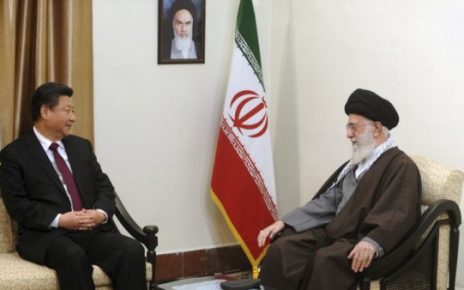

“The Iranian negotiators are very different and ‘strange,’ Trump wrote on Truth Social. “They are ‘begging’ us to make a deal, which they should be doing since they have been militarily obliterated, with zero chance of a comeback, and yet they publicly state that they are only ‘looking at our proposal.’”
“WRONG!!!” the president continued. “They better get serious soon, before it is too late, because once that happens, there is NO TURNING BACK, and it won’t be pretty!”
*
Some will see this as a threat from Donald Trump to Iranians that Trump is seriously considering using nuclear weapons, making the removal of Trump – and Netanyahu – from power all that more necessary and urgent.