Occupying a very powerful position within the Hungarian Government, Anita Orbán is undoubtedly a name we will be hearing for years to come. Whether you supported Fidesz, welcomed the eagerly presented change promised by TISZA, or stood somewhere in between, Europeans of every age and circumstance should be asking who Anita Orbán is and to whom she is loyal.

On April 12, 2026, Péter Magyar, representing the Tisza Party, won the Hungarian election with a supermajority, thus ending Viktor Orbán’s 16-year tenure as Hungary’s Prime Minister under the Fidesz Party. Soon after the election, Magyar formally appointed Anita Orbán, no relation to Viktor Orbán, to serve as Foreign Minister and Deputy Prime Minister. She was sworn into office in mid-May.
Anita Orbán’s Higher Education and Training (1998–2007)
Hungary’s new Foreign Minister and Deputy Prime Minister Anita Orbán spent several years in the United States while receiving part of her education between 1998 and 2002. It is well known that during this time, Orbán received two master’s degrees from Tufts University — one in History and one in Law and Diplomacy. In 2001, she began her doctoral studies, for which she would later receive a Ph.D.
Her 2007 Ph.D. dissertation titled, “Tanks Have left, Gazprom is back: Russian Energy Companies’ Expansion Towards Poland, Slovakia and Hungary Between 1991 and 2004” includes a Curriculum Vitae (CV). While not a standard practice, the CV confirms well-known biographical information about Orbán and also provides additional work details including her foreign policy internship at the Heritage Foundation, a conservative think tank, in the summer of 2000. Orbán previously elaborated on this experience during an interview with then-candidate Péter Magyar in early 2026.
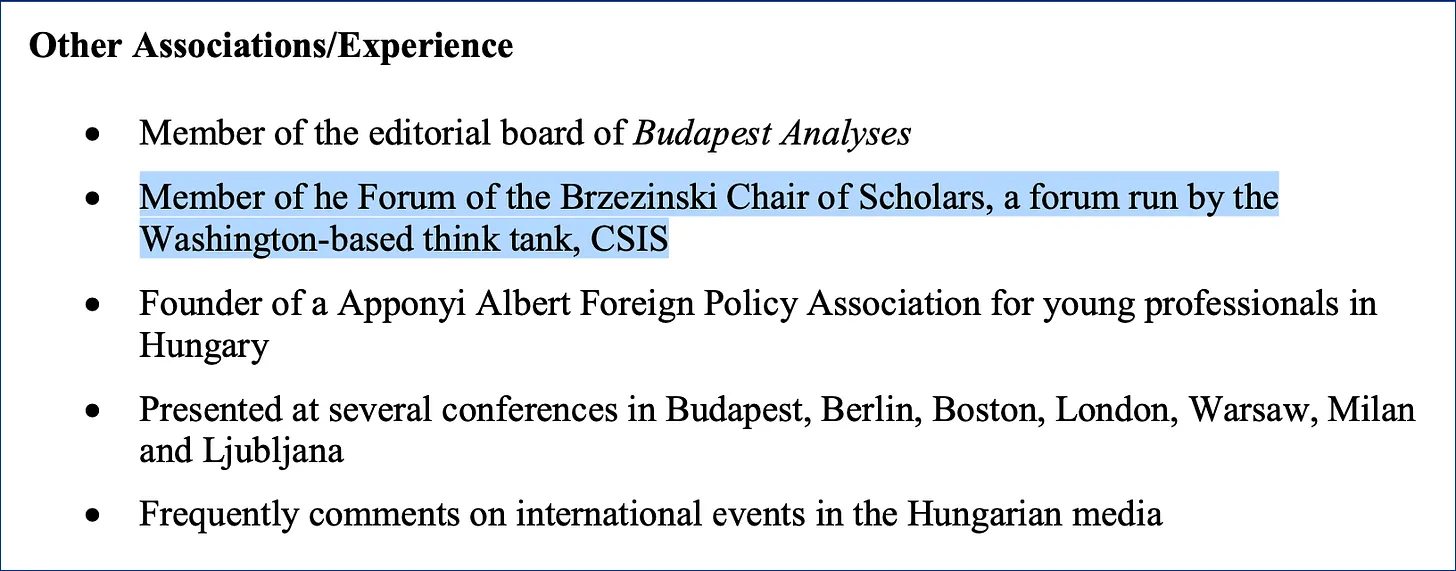
In the summer of 2001, Orbán worked as a Research Associate at the Hudson Institute, an American research organization focused on defense, international relations, economics, energy, culture, technology, and more. Orbán also held a position with the Forum of the Brzezinski Chair of Scholars, which was organized by the Center for Strategic and International Studies (CSIS).
Name Dropping in Her Dissertation
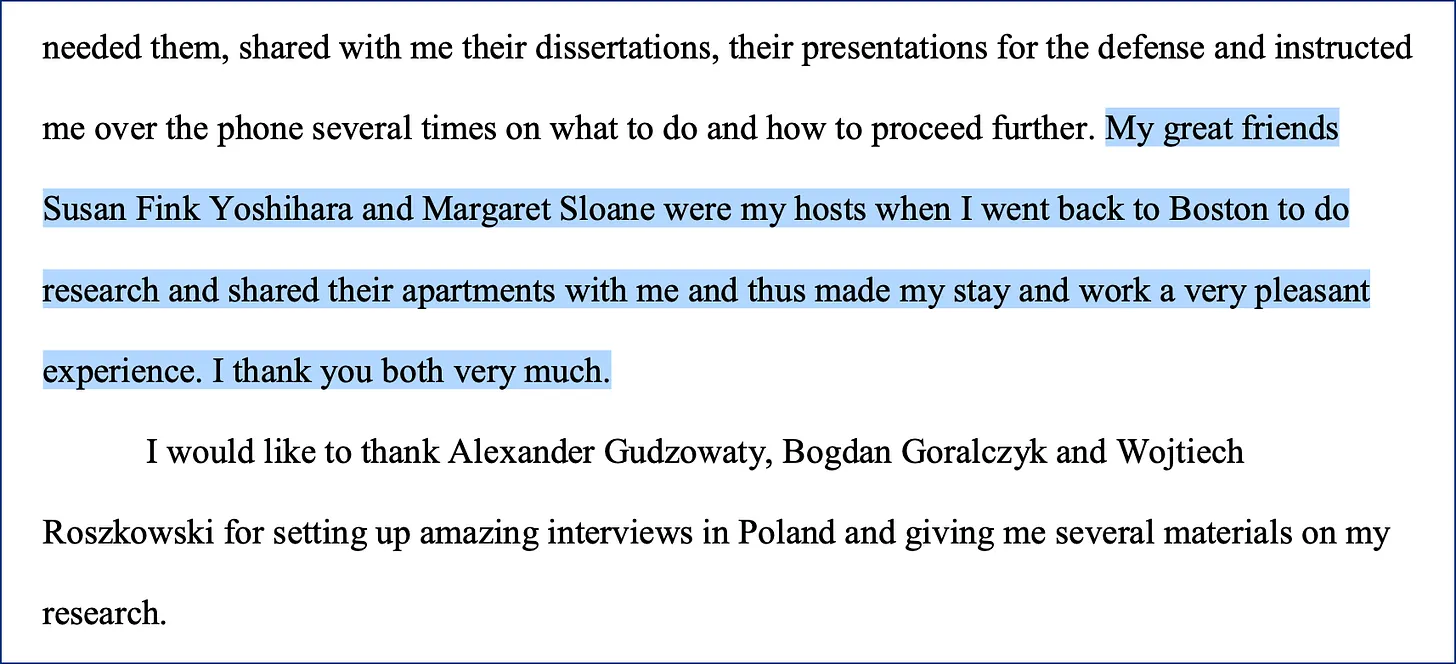
In addition to her CV, Anita Orbán wrote a lengthy acknowledgment section, which contains personal life details as well as the full names of friends, mentors, and colleagues who supported her throughout her doctoral research. In one paragraph, she specifically references two women: Susan Fink Yoshihara and Margaret Sloane. Orbán wrote, “My great friends Susan Fink Yoshihara and Margaret Sloane were my hosts when I went back to Boston to do research and shared their apartments with me and thus made my stay and work a very pleasant experience. I thank you both very much.”
Susan Fink Yoshihara received a Ph.D. in International Relations from the Fletcher School at Tufts University. She is the author of Waging War to Make Peace: U.S. Intervention in Global Conflicts, which examines “the decision-making of four NATO nations―Britain, France, Germany, and the United States―in the 1999 Kosovo campaign” and compares this with “decisions in 2003 regarding the Iraq War.” More broadly, the book examines why larger, powerful nations intervene in smaller wars.
In addition to her writing and academic work, Yoshihara is the founder and President of Women, Peace and Security (WPS) Council — a nonprofit organization of professionals that delivers “high impact education and policy analysis from (our) experience in the fields of national security, international law, development, religious liberty, human rights, and humanitarian action.” The WPS Council works alongside the U.S. Government and non-governmental organizations to maintain the objectives outlined in the U.S. Women, Peace and Security Act of 2017.
According to the WPS Council’s website, the organization’s mission is to “advance peace and security for women, their families, and communities through innovative education and policy design, thought leadership, and on-the-ground engagement.” Additionally, the organization “promote(s) foundational American principles of human dignity, individual liberty, and equality of opportunity for all.”
When serving as a Senior Advisor at USNORTHCOM and NORAD’s WPS Team, Susan Yoshihara advised the Department of Defense. She also provided expert testimony on human trafficking and on women and children in post-conflict peacebuilding, among other subjects, before the United Nations (UN), the Senate Foreign Relations Committee, the UN Security Council, and the UN Economic and Social Council.
Yoshihara has extensive military experience, having served 20 years as an active-duty Navy helicopter pilot. During this time, she “led combat logistics missions in the Gulf War, conducted humanitarian assistance missions in Africa, Asia, and the Pacific Islands, and served on the personal staff to the combatant commander of the U.S. Atlantic Fleet/NATO Striking Fleet.” Yoshihara taught National Security Affairs, International Relations and related disciplines at the U.S. Naval War College. She was a White House Fellow from 1996 to 1997.
According to Yoshihara’s LinkedIn profile, she received Secret Security Clearance with the U.S. Department of Defense in January 2021 and a Certificate in Refugee Trauma from Harvard Medical School in April 2021.

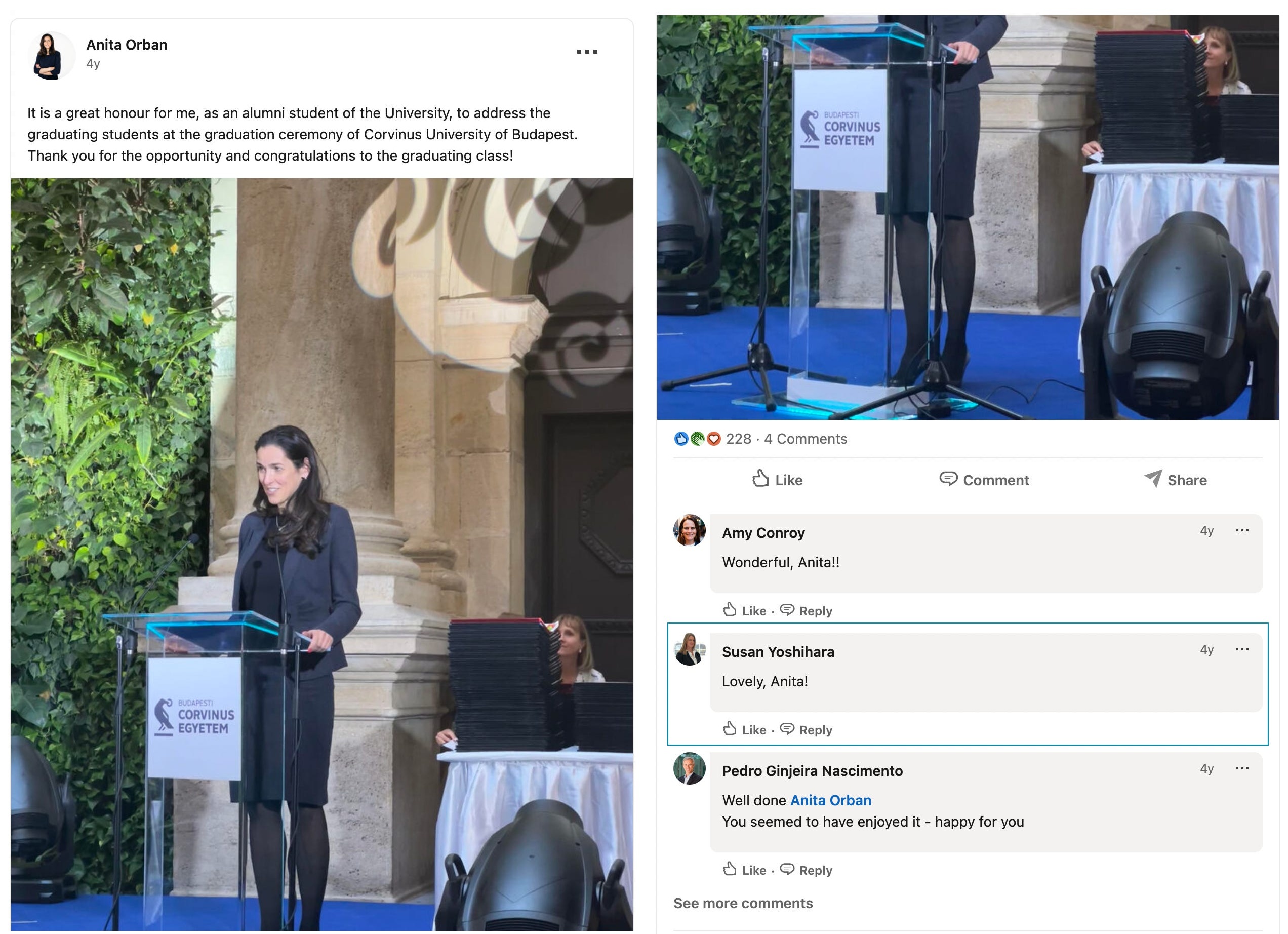
It is not clear what the current relationship is between Yoshihara and Anita Orbán. However, as recently as 2022, Yoshihara commented on a photo posted by Anita Orbán in which Orbán is speaking to graduating students during the Corvinus University commencement ceremony that year. Yoshihara commented, “Lovely, Anita!”
The other friend mentioned by Anita Orbán is Margaret Sloane, who also earned a Ph.D. from the Fletcher School at Tufts University. According to Sloane’s LinkedIn profile, she has been employed with the U.S. Department of Health and Human Services (HHS) in the Administration for Strategic Preparedness and Response since February 2021. Her specialties include weapons of mass destruction and national security.
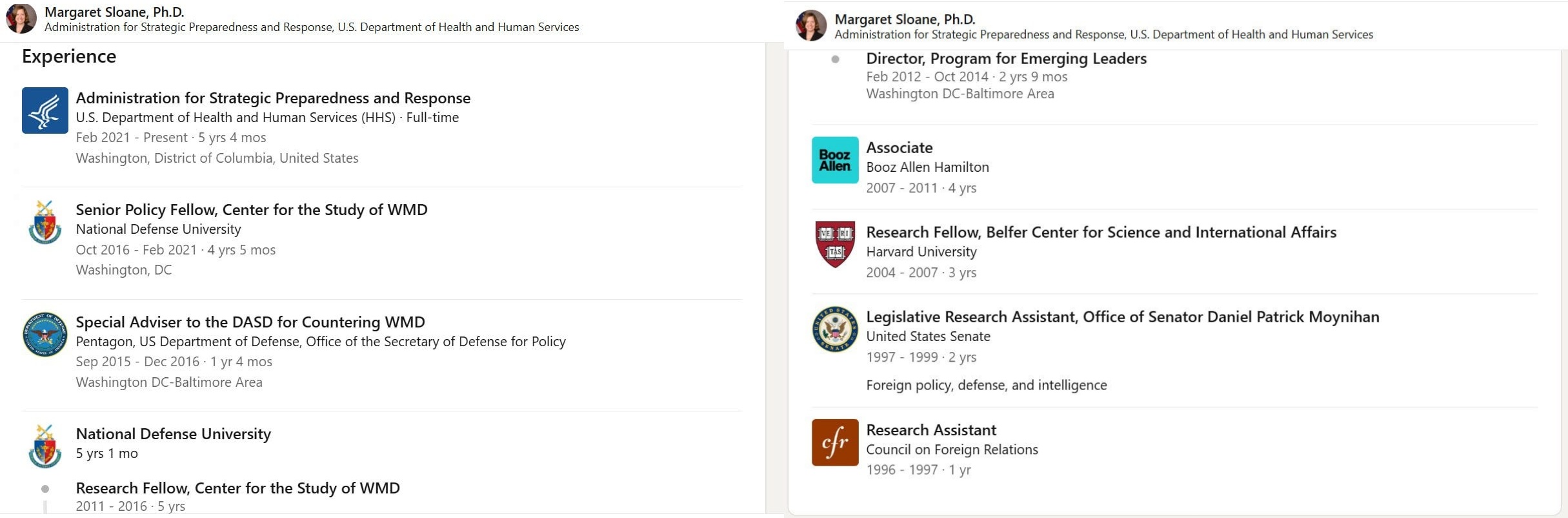
Sloane previously served as a Special Advisor to the Deputy Assistant Secretary for Defense (DASD) for Countering Weapons of Mass Destruction (WMD) at the Pentagon. She worked as an Associate at Booz Allen Hamilton and held a position as a Senior Policy Fellow at the Center for the Study of WMD at National Defense University. From 1996 to 1997, Sloane worked as a Research Assistant with the Council on Foreign Relations.
Earlier this year, Margaret Sloane “loved” and shared Anita Orbán’s LinkedIn post promoting the Tisza Party.
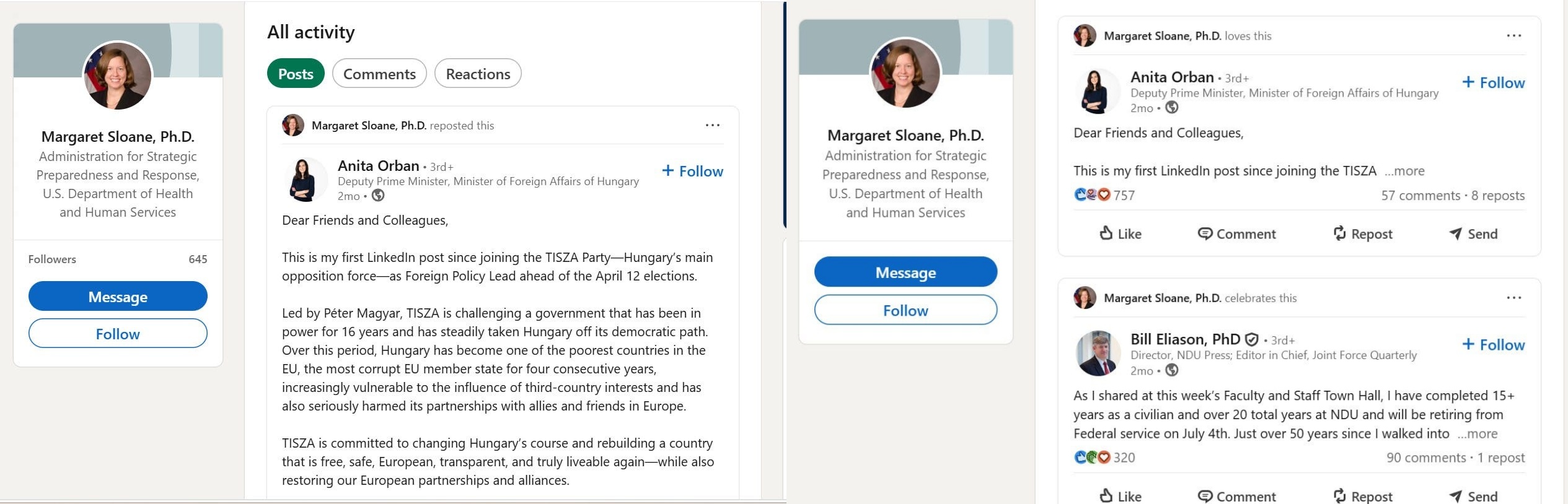
Similar to Yoshihara, it is unclear how close their relationship is today, but the recent LinkedIn activity suggests, at the very least, that Orbán and Sloane remain in touch and support each other.
A Network Emerges — The Fed, CFR, and DARPA Connections
While pursuing her Ph.D. beginning in 2001, Anita Orbán was advised by a committee of three faculty members, including the chair Dr. Robert L. Pfaltzgraff Jr., Dr. Lisa Lynch, and Dr. William C. Martel.
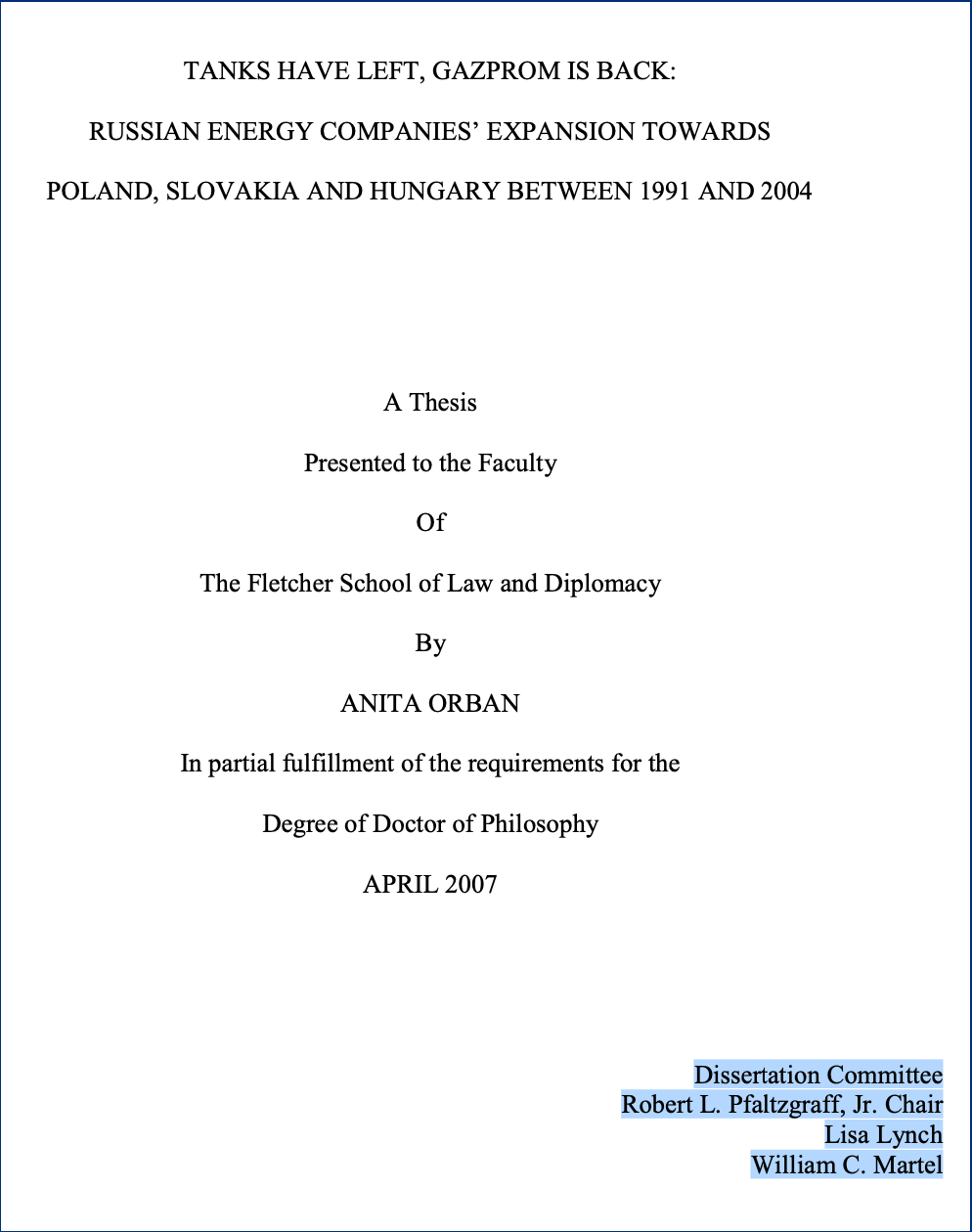
Orbán’s dissertation committee chair, Dr. Robert L. Pfaltzgraff Jr., was a Professor at The Fletcher School at Tufts University beginning in 1971. After Pfaltzgraff passed away in late 2023, The University of Pennsylvania published a tribute in his honor, which stated he was “the visionary behind the establishment of Fletcher’s International Security Studies Program, laying the foundation for numerous graduates to embark on impactful careers in foreign service and security intelligence.” And one of those graduates was Anita Orbán.
In 1976, Pfaltzgraff founded and served as President of the Institute of Foreign Policy Analysis (IFPA). According to an archived State Department website, the IFPA is an independent organization that conducts research, prepares policy briefings, and organizes conferences and seminars in the U.S. and internationally. The IFPA focuses on a broad range of issues including “proliferation, countering weapons of mass destruction, the future of alliances, security cooperation, national security strategy, military modernization and transformation, homeland security” and more. Similarly, according to the State Department’s profile on Pfaltzgraff, he specialized in international relations theory, counterproliferation, homeland security, missile defense, space strategy, the long war against terrorism and more.
Pfaltzgraff’s work went well beyond academic affiliations. He held high-ranking positions advising government officials on military and defense strategy, terrorism, national security, and homeland security. He was a member of the Reagan Defense Advisory Team and briefed President George Herbert Walker Bush, Condoleezza Rice, and others on foreign policy planning after the fall of the Soviet Union.
Published in a batch of Central Intelligence Agency (CIA) archives, a letter dated January 1984 shows Pfaltzgraff was on a first-name basis with the then-National Intelligence Officer for Western Europe Milton Kovner. In Kovner’s letter addressed to “Bob,” he inquired if Pfaltzgraff would be available to open a session during a conference titled, “Europe in the Eighties,” which was to be held in the State Department in April that year. A few days later, Pfaltzgraff responded and accepted the invitation to speak specifically on “NATO and Western Defense: European Views.”

Pfaltzgraff was also a member of the Council on Foreign Relations (CFR) and served as co-chair of the Independent Working Group on Missile Defense. From 2006 to 2009, he was a Board Member of the International Security Advisory Board (ISAB) of the State Department.
When reflecting on Pfaltzgraff’s advice and guidance in the acknowledgment section of her dissertation, Anita Orbán wrote, “I am thanking the chair of my committee, Professor Pfaltzgraff for his comments and remarks on earlier drafts of the dissertation, which together with his clear guidance were instrumental in building the cases, writing the theoretical chapter, structuring the problem and sharpening the argument. The fact that he commended the theory chapter means a lot and makes all the work worthwhile.”
The second advisor on Anita Orbán’s doctoral committee was Dr. Lisa Lynch, an economist who has held numerous positions with the Federal Reserve and other economic and financial institutions. At the time that Lynch was advising Orbán, she was a William L. Clayton Professor of International Economic Affairs at the Fletcher School at Tufts University.
From 2004 to 2009, Lynch was a Director of the Federal Reserve Bank of Boston and became Chair of the Board of Directors of the Federal Reserve Bank of Boston between 2007 and 2009. Additionally, in 2009, Lynch became Chair of the Conference of Chairmen of the Federal Reserve System. Lynch would go on to become a member of the Economic Advisory Panel of the Federal Reserve Bank of New York from 2018 to 2024. Currently, she is the 2025-2026 Stone Visiting Scholar and Visiting Professor of Public Policy at the Harvard Kennedy School.
Dr. William C. Martel was the third advisor to join Anita Orbán’s dissertation committee. In addition to working as a Professor at the Fletcher School at Tufts University, Martel was a Professor of National Security Affairs at the Naval War College. He was also Director of the Center for Strategy and Technology at the Air War College.
According to a biography associated with Martel’s academic work, he “directed a number of studies on space and policy issues for the Defense Advanced Research Projects Agency (DARPA), the U.S. Air Force, and the Office of Secretary of Defense.” The Defense Advanced Research Projects Agency (DARPA) is the agency within the Department of War (formerly the Department of Defense) that tests new military technology and is known for pushing ethical boundaries.
In 2006, Martel’s review of a previous work titled, The E-Bomb: How America’s New Directed Energy Weapons Will Change the Way Future Wars Will Be Fought by Doug Beason was published in the Naval War College Review. The original work examines the future use of directed-energy technologies in warfare.
Martel authored and edited several written works including The Technological Arsenal: Emerging Defense Capabilities, published in May 2001. According to an Amazon summary of the book, Martel and the expert contributors “describe the development, analyze the capabilities, and measure the implications of emerging technologies that will mature within the next five years and beyond, organizing them in three broad categories: directed energy, targeting, and command and control.” The book does not advocate for any particular program; each chapter reviews a technology already approved or funded by U.S. Congress. A review of the book was published in Foreign Affairs on September 1, 2001.
Beyond academics and research, Martel was a professional staff member at the RAND Corporation in Washington, D.C. He had experience in shaping foreign policy, serving as an advisor to the National Security Council between 2008 and 2010. He was also a Senior Foreign Policy Advisor to then-Governor Mitt Romney during his 2012 presidential campaign. According to a former colleague who worked with Martel on Romney’s foreign policy team, it was Martel who advised then-Governor Romney on Russia and “helped formulate the position that Russia was a geostrategic threat.”
Anita Orbán shared the following about Dr. William C. Martel in her dissertation acknowledgement section, “I am thankful for Professor Martel for joining my committee at a later stage and offering all his time to make me finish as planned. Professor Martel’s comments made me sharpen the argument and were also essential in polishing the dissertation’s style and language.”
At the conclusion of Anita Orbán’s dissertation, the bibliography section includes her interviews, regular consultations, references, and works cited. In the “Author’s interviews” section, it lists former CIA Director James Woolsey. The reference indicates that Orbán interviewed Woolsey in Washington, D.C. in October 2000.
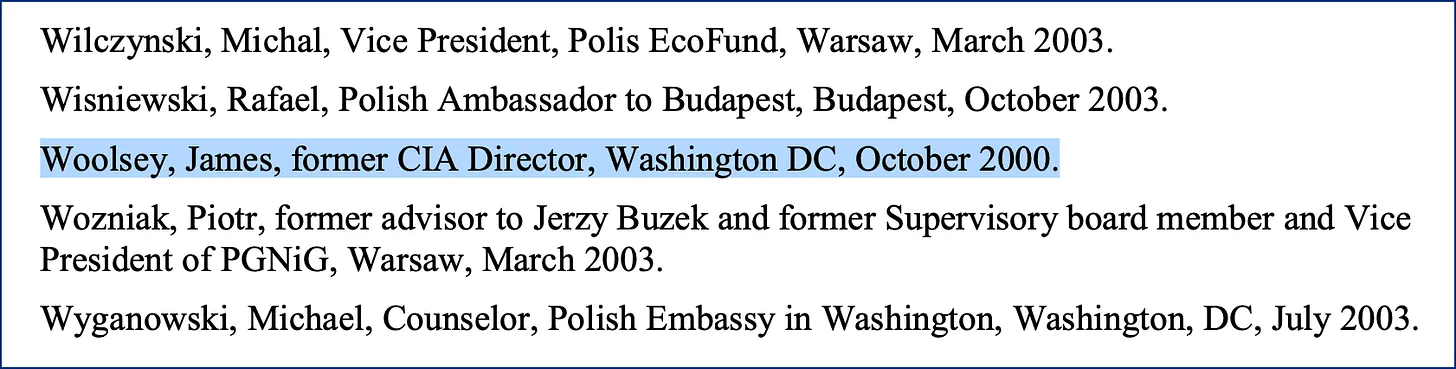
Woolsey served as head of the CIA from 1993-1995 during the Clinton Administration, and he previously held positions in the Carter, Reagan and George H. W. Bush Administrations. Woolsey also served as Ambassador to the Negotiation on Conventional Armed Forces in Europe from 1989 to 1991.
For the purposes of Orbán’s dissertation, she may have met with Woolsey due to his experience in energy security. Woolsey served as a chair member of the United States Energy Security Council. According to the State Department’s profile featuring Woolsey, in July 2002, he joined Booz Allen Hamilton as the Vice President of the Global Strategic Security division. The following month in August 2002, he became a distinguished advisor for the Foundation for Defense of Democracies (FDD), a research institute focused on national security and foreign policy, which was established shortly after September 11, 2001.
Cold War Propagandists Make a Comeback
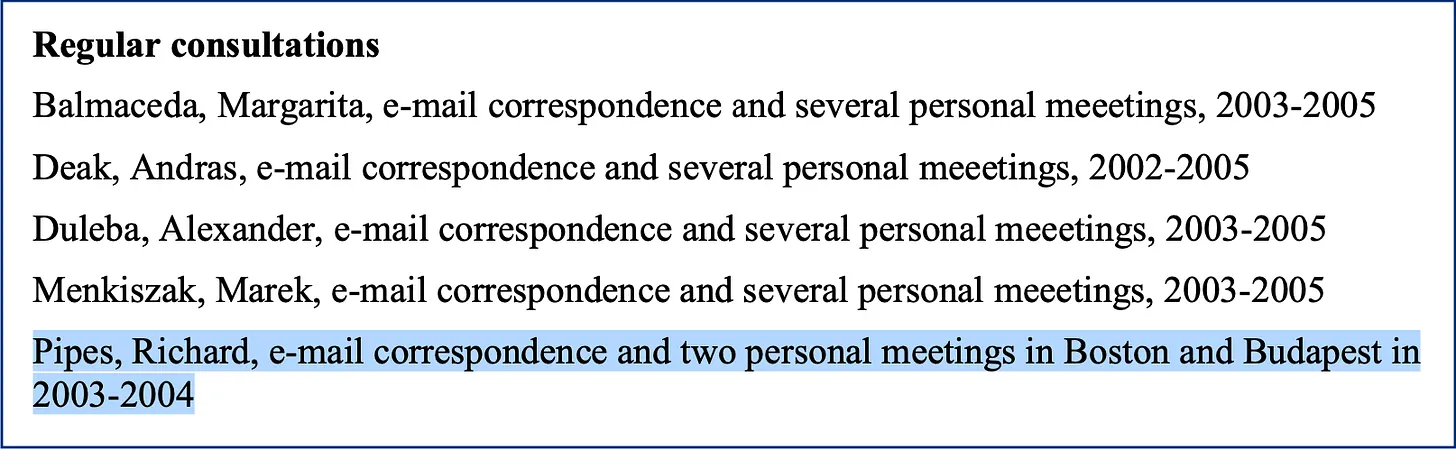
Another notable reference in Anita Orbán’s bibliography can be found in the “Regular consultations” section, which lists historian Richard Pipes. The reference indicates Anita Orbán corresponded with Richard Pipes via email and that the two met twice, once in Budapest and once in Boston, between 2003 and 2004.
Richard Pipes was a history professor at Harvard University with a specialization in Russia and the Soviet Union. He authored many books on the subject and spent the majority of his career in academia from 1958 until his retirement in 1996. Pipes, who was a member of the Council on Foreign Relations, held prominent positions as a foreign policy advisor to U.S. Presidents, and more broadly, the U.S. Intelligence Community.
In the early 1980s, Pipes took a brief leave of absence from Harvard to serve on the National Security Council under the Reagan Administration from 1981 to 1982. In this role, Pipes advised the Administration on its policy toward the Soviet Union, and he was the primary author of two National Security Decision Directives, including the NSDD-32 and NSDD-75. Put simply, both directives increased U.S. aggression toward the Soviet Union and became fundamental components of the Reagan Doctrine, which was a foreign policy initiative aimed at supporting anti-communist rebels.
Pipes is arguably most well-known for his effort leading the 1976 Team B exercise. Team B consisted of a group of military analysts and experts, who were tasked with assessing the CIA’s 1975 National Intelligence Estimate (NEI) on Soviet Strategic Objectives. Team B was created by the then-CIA Director George H. W. Bush.
In its assessment, Team B determined that the CIA underestimated the threat of the Soviet Union. According to the Team B Intelligence Report, “Team B feels the USSR strives for effective strategic superiority in all the branches of the military, nuclear forces included… Their military doctrine is measured not in Western terms of assured destruction but in those of a war-fighting and war-winning capability.” Put simply, Team B argued the Soviets did not view nuclear weapons as a deterrent.
Today, assessments of the Team B Intelligence Report indicate that Team B exaggerated the threat of the Soviet Union and relied on the perceived ideological motives of the Soviets rather than observable and measurable data. Years later, Richard Pipes would continue to perpetuate and uphold the Team B findings, emphasizing the importance of understanding the Soviet and Russian mindset.
In an interview from around 2009, presumably in affiliation with The Ronald Reagan Presidential Foundation, when asked what he would change to improve the CIA’s effectiveness, Pipes responded that it would be to change their understanding of the Soviet/Russian mindset (throughout the interview Pipes often uses “Soviet” and “Russian” interchangeably). Pipes remarked that CIA officials and graduates of American universities, in general, have difficulty understanding the Soviet mentality.
“They assume basically we’re all the same, and they think pretty much the same way that we do,” Pipes said. “And I had great difficulty persuading them of it… that the Russians think differently.” Pipes said President Reagan, in particular, had a hard time grappling with the idea that the Soviet/Russian leadership did not want the Russian people to be prosper but preferred them to be weak and poor, according to Pipes. “And because he (Reagan) was a nice man, he couldn’t understand that leaders would not want the well-being of their people.”
One could argue that Pipes’ focus on persuading the U.S. leadership that the Soviet/Russian mindset is fundamentally different from those in the West, is a tactic that could lead to the dehumanization of an entire group. Furthermore, following the collapse of the Soviet Union, Pipes’ negative perspective on the Russians extended beyond the leadership to the general population as well.
In the 2009 interview, Pipes argued that given the Russian population’s current support for the leadership, all Russians must share a similar mindset to those within the government. Pipes went on to reference an article he wrote in Foreign Affairs Magazine several years earlier, in 2004, titled, Flight From Freedom. Pipes stated that “it (his article) showed that the (Russian) population thinks very much the way the government does — that freedom is not important, that what is important is order and security, that the West is hostile, and so on.”
Thus, during the early 2000s, at the time when Richard Pipes was corresponding and meeting with Anita Orbán for her doctoral dissertation, he held negative, and arguably prejudicial, views on Russians. This is evidenced in his previously referenced comments as well as a report covering his 2005 Pew Memorial Lecture at Grove City College, in which he argued that Russia was not a democracy but an autocracy. At the time, he also shared that he did not have much hope for the country’s future.
One must now consider if and how Pipes may have influenced Anita Orbán’s perspective on Russia and the Russian people, and how this could impact her strategy and decision-making as Foreign Minister of Hungary.
Mentored by a Bohemian Grove and Bilderberg Attendee
Aside from Pipes’ academic and professional work, his social affiliations raised serious questions. In a 2003 C-SPAN interview with Brian Lamb, Richard Pipes confirmed he attended the Bohemian Grove, a controversial secret gathering which included former U.S. Presidents Reagan and Bush as well as military officials, businessmen and others among the powerful elite. Without shame, Pipes shared that the Bohemian Grove is, in fact, an exclusive gentlemen’s club and that he was invited to attend by a friend.
When asked for more details, Pipes confirmed he was invited after he served as an Advisor on the National Security Council. Pipes also disclosed that he attended two Bilderberg meetings and met Henry Kissinger at one of them. Pipes reflected on this, and it appeared the two had a contentious, or perhaps rivalrous, relationship.
And despite this publicly confirmed association between Pipes and secret organizations, Anita Orbán would continue to maintain a working relationship with Pipes. In fairness, others in Anita Orbán’s circle, not just Pipes, had strong connections to elite societies, including some members of the Bush family. Furthermore, Pipes would continue to be revered by some political factions despite this controversy and despite the inaccurate Team B assessment report.
Anita Orbán’s Career Post-Ph.D. (2007-2010)
Anita Orbán eventually earned her Ph.D. in 2007. During this time, she and her then-husband, Krisztián Orbán, had been living in Budapest for several years after moving back from the U.S. in 2002. Anita Orbán was serving as the Deputy Director of the International Centre for Democratic Transition. According to an archived website, the organization’s purpose was “to collect and share the experiences of past democratic transitions.” George Herbert Walker, the first cousin of former President George W. Bush, and Donald Blinken, the father of former Secretary of State Antony Blinken, were among the international board members. Both men previously served as U.S. Ambassadors to Hungary.

It is important to note that at this time, in 2007, Anita was still married to Krisztián Orbán. It is unclear when the couple divorced, but based on reports, it appears they were still married until at least 2010.
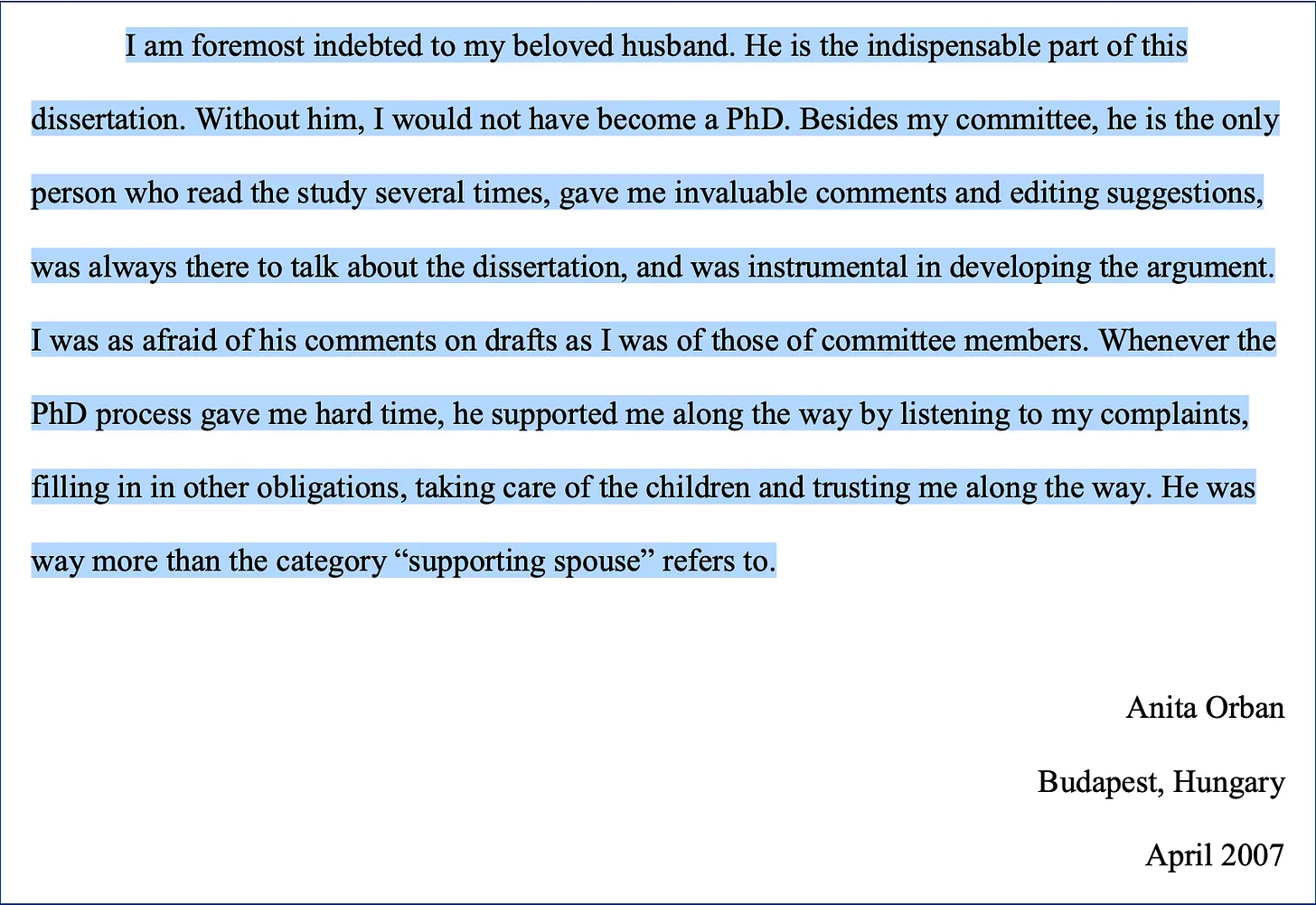
Around 2007, one can reasonably assume that the two shared a very close professional bond as evidenced in Anita Orbán’s acknowledgment section of her Ph.D. dissertation in which she gives an extensive thanks to her then-husband Krisztián.
Business Ventures with the American Elite
In 2007, Krisztián Orbán, co-founded the company, Oriens, which is involved in the acquisition of medium-sized companies that it then expands to become larger, successful businesses. Oriens’ website states that they “de-bottleneck” these companies and “facilitate their fast growth.” The website goes on to state, “We own nine companies, all of which are considerably bigger than upon acquisition. We are also proud that all of the original owners are happy with the development of their former company.”
During Oriens’ early years, it relied on the immeasurable support of Ambassador George Herbert Walker and the moral and financial support from Peter Holtzer and the advice of John C. Whitehead.
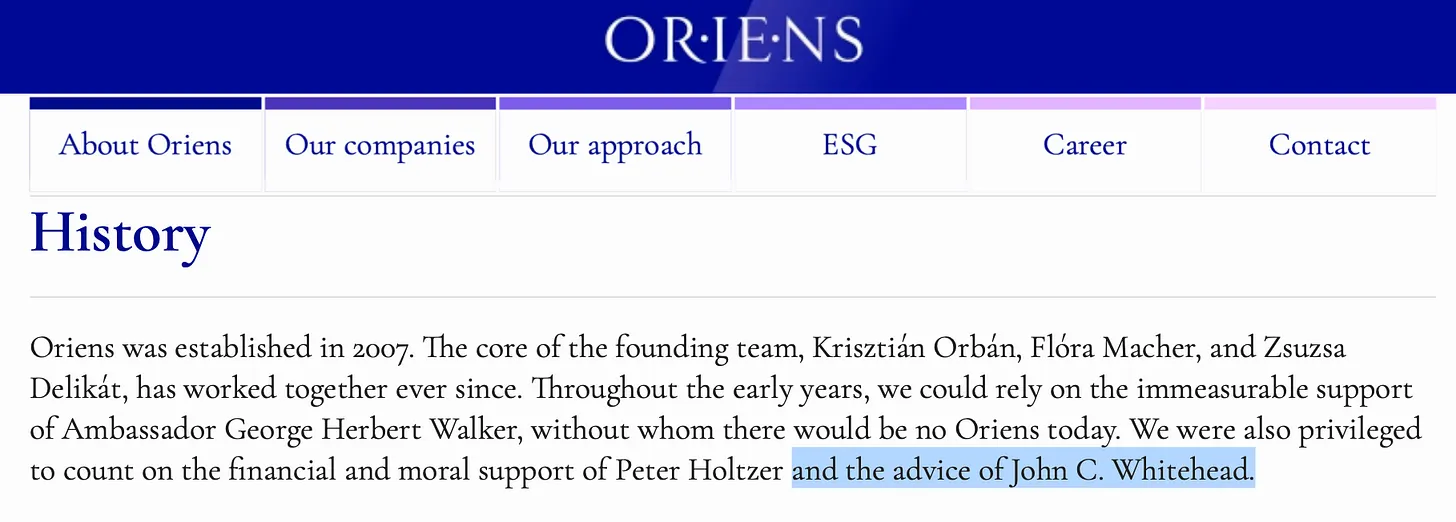
John C. Whitehead was a prominent figure within the U.S. Establishment. He was a banker, who worked at Goldman Sachs, and he was a chairman of The Federal Reserve Bank of New York. Following September 11, 2001, he was appointed by then-Governor of New York George Pataki to chair the board of the Lower Manhattan Development Corporation. He was also a chairman of the World Trade Center Memorial Foundation.
Hungary Foundation, an organization focused on fostering American-Hungarian relations, published a tribute in honor of John C. Whitehead when he passed away, which referenced his support for many pro-Hungary initiatives. The tribute included that “While at Goldman Sachs, Mr. Whitehead traveled to Vienna in 1956, just as the revolution in Hungary broke out. He was deeply affected by the plight of Hungary’s freedom fighters and took significant measures to assist them.”
An article in the Hungarian press from 2009 reported that Oriens launched a venture capital fund with Bush’s cousin as well as George Pataki, the former Governor of New York. Thus, while a clear business connection among Whitehead, Ambassador Walker and Krisztián Orbán can be established, Anita Orbán seems to have her own connection to the Bush family, either through her then-husband or through her own affiliations.

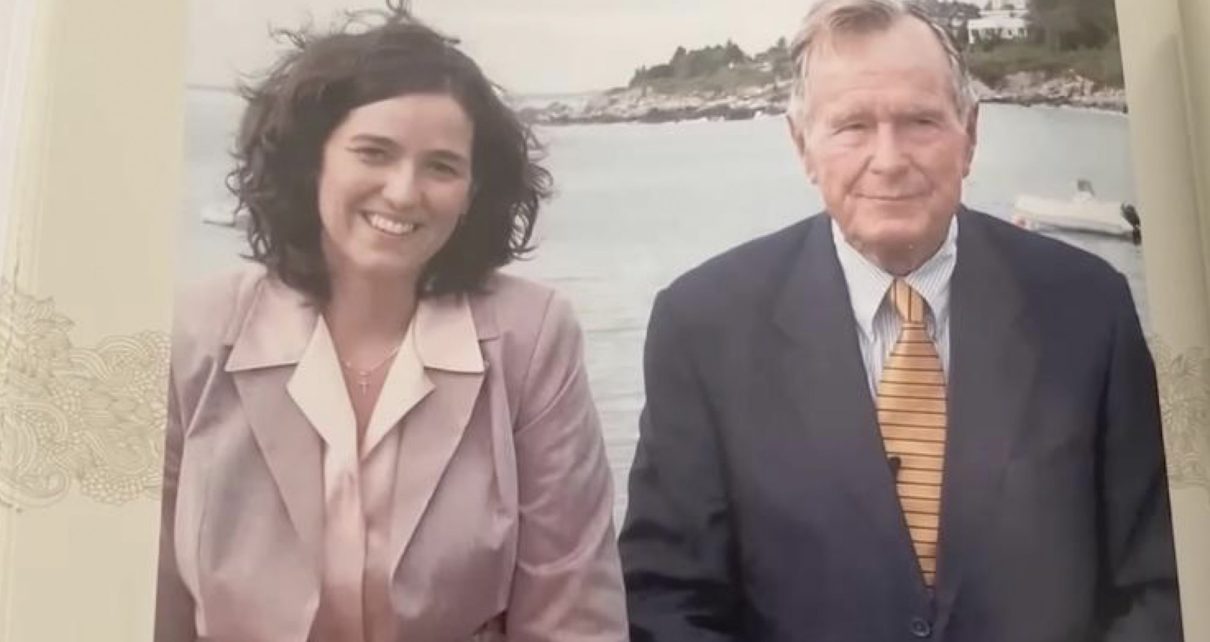
The above photo shows Anita Orbán sitting next to former President George H. W. Bush (Bush Sr.) at what appears to be Walker’s Point Estate in Maine in the 2000s. However, the exact date and location of this photo is not yet confirmed. The picture was included in an interview between Anita Orbán and Péter Magyar published in early 2026. And while little is known about this photo, it provides further evidence of Anita Orbán’s connection to the American elite.
American Friends Leave an Impression
Around 2003, Anita Orbán published a book titled, The Impact of Anti-Communism on U.S. Conservatism. The book was published in Hungarian and focuses on anti-communist ideology and its impact on the neoconservative movement in America. The book features the election and presidency of Ronald Reagan. And interestingly, John C. Whitehead served in the Reagan Administration as Deputy Secretary of State, making him the fourth individual (referenced here, there may be more) connected to Anita Orbán who worked under Reagan. (The other three previously mentioned include Robert L. Pfaltzgraff Jr., the chair of Anita Orbán’s dissertation committee, Richard Pipes, who consulted with Anita Orbán for her doctoral dissertation and former CIA Director James Woolsey, whom she interviewed for her dissertation.)
In 2008, Anita Orbán wrote another book, Power, Energy, and the New Russian Imperialism, which was published in the United States. The book advocates for the European Union (EU) Member States’ adoption of a centralized policy toward Russia. It also argues in favor of Hungary moving away from reliance on Russian energy.
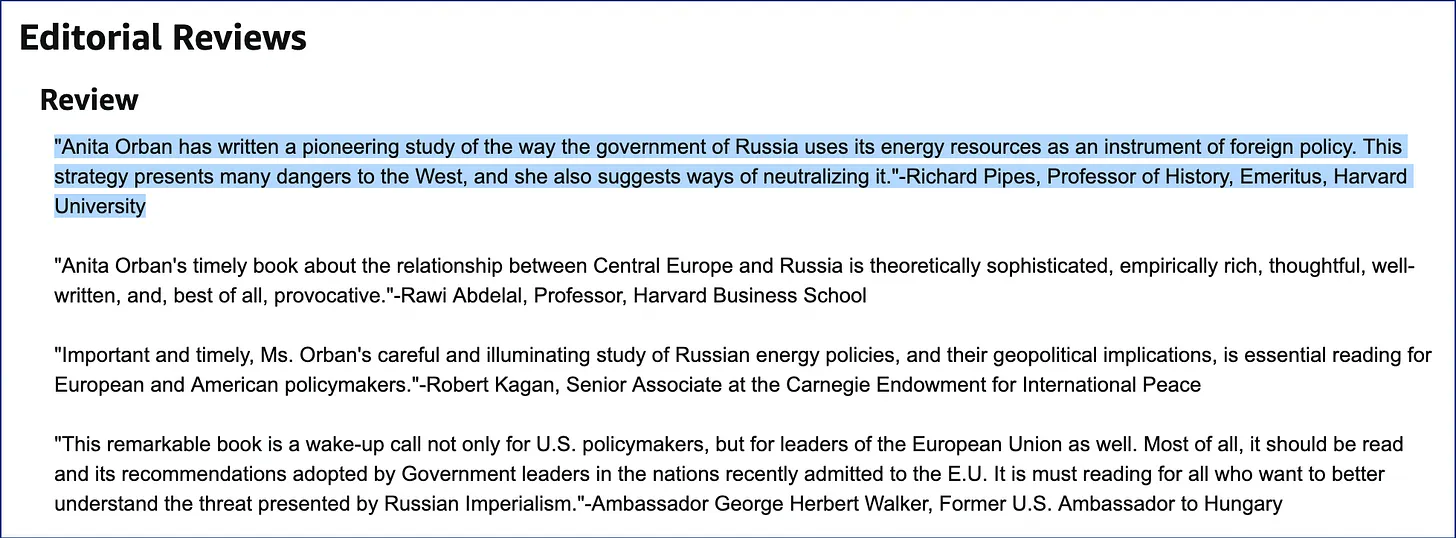
Orbán’s 2008 book received endorsements from U.S. Ambassador Walker and Robert Kagan — a former State Department official during the Reagan Administration and the husband of Victoria Nuland. The other notable review came from Anita Orbán’s former advisor, Richard Pipes, who said, “Anita Orbán has written a pioneering study of the way the government of Russia uses its energy resources as an instrument of foreign policy. This strategy presents many dangers to the West, and she also suggests ways of neutralizing it.”
It is important to remember that by at least 2003, Pipes’ attendance at the Bohemian Grove and Bilderberg, was public knowledge following the CSPAN interview in which he admitted to these affiliations.
In 2010, Anita Orbán was nominated as a Fidesz candidate for the National Assembly. However, she withdrew her nomination rather abruptly citing health reasons. The withdrawal of her candidacy coincided with reports that her then-husband’s former company was under investigation by the police. This left many to question her official reason for withdrawing her candidacy. Yet, despite this short-lived political run, and the controversy and speculation that followed, it would be of little consequence to her overall career.
Lobbying and Applauding the U.S. Leadership
Between 2010-2015, Anita Orbán served as Ambassador-at-Large for Energy Security representing Hungary. In her role as Ambassador, in March 2014, Anita Orbán testified before the U.S. House Subcommittee on Energy and Power. She was one of several experts to speak before the Subcommittee during a hearing on House Resolution 6 (H.R. 6) titled, Domestic Prosperity and Global Freedom Act. The Resolution was introduced by then-Republican Representative Cory Gardner.
During his opening statement, then-Rep. Gardner stated that the bill “grants approval for completed LNG (liquefied natural gas) export applications that are currently languishing at the Department of Energy and would modify the standard of review for future export applications by shifting the benchmark from Free Trade Agreement (FTA) countries to World Trade Organization (WTO) member countries.” To put it simply, the proposal would make it easier and quicker for the U.S. to export LNG to more countries.
Rep. Gardner also commented on the current geopolitical situation in Eastern Europe, through his perspective, and argued the perceived geopolitical benefits of H.R. 6, stating, “the near monopolistic control Russia has on the LNG market in Europe has given them immense power, and reforming the LNG export process would send an immediate signal to the rest of the world that would help check Russia’s aggression.” On the following day of the hearing, Rep. Gardner remarked that “opposing this legislation is like hanging up on a 911 call (112 emergency) from our friends and allies.”
Furthermore, Rep. Gardner advocated for U.S. energy independence and argued that it was possible for the U.S. to be self-reliant while also exporting LNG to other countries. In another reference to the perceived geopolitical advantage of his proposal, Rep. Gardner claimed that “energy produced here at home and sent overseas means we are sending energy and not our troops.”
Reiterating the same sentiment, Anita Orbán delivered her testimony, arguing in favor of the proposal. She began by stating, “We applaud the leadership.” This was in reference to the relevant American congressional officials who proposed and advocated for the Resolution. Orbán then shared that “On March 6, four Ambassadors of the four Visegrad countries signed a letter to Speaker Boehner and Majority Leader Harry Reid to urge them to recognize the overall importance of U.S. engagement in Central/Eastern Europe, and more specifically, in the area of energy security.”
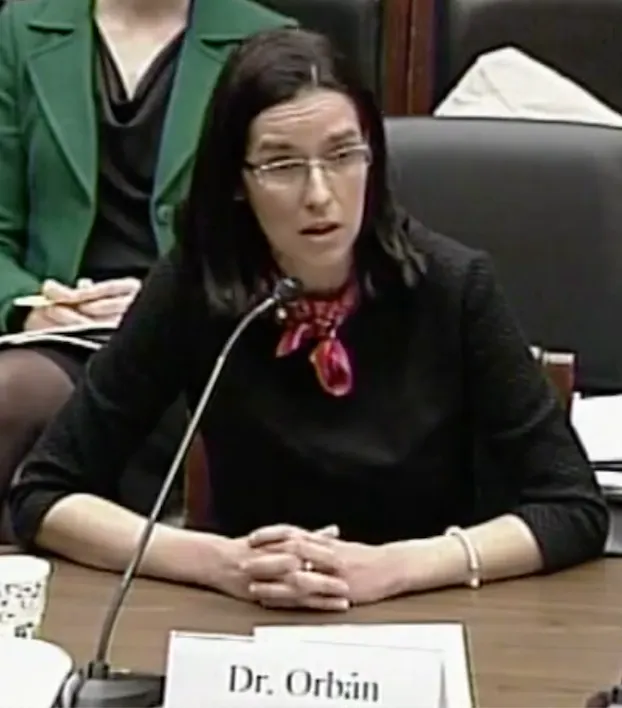
In continuing her plea to encourage U.S. Congress to support the Resolution, Orbán claimed that providing LNG helps Ukraine and sends a strong geopolitical signal. She emphasized, “There is nothing like a crisis to focus the mind. As Representatives of a country that Central/Eastern Europe has traditionally looked to for leadership, you know well that you do not always have the luxury of choosing the time to make some of the most necessary decisions. But with the post-Cold War settlement crumbling before our eyes, if there was ever a time for your leadership, it is now.”
H.R. 6 passed the House in June 2014. It was received in the Senate but did not progress further through the legislative process. In 2015, Anita Orbán left her position as Ambassador for Energy Security and entered the private sector, where she would work for several years, including as a Chief Advisor for Cheniere Marketing and as Vice President for International Affairs with Tellurian LNG from 2017-2020.
Emerging Interests, Telecommunications and Digitization
In recent years, Anita Orbán worked as the External Affairs Director of Vodafone Hungary beginning January 2021. During this time, and until very recently, Orbán served on the Board of Directors of GLOBSEC, a think tank focused on security and sustainability, with offices in several European cities as well as in Washington, D.C. and Kiev. GLOBSEC is partnered with organizations such as Microsoft, Amazon, Google, Lockheed Martin and others. Throughout the years, Orbán has spoken at several Atlantic Council Forums.
Her recent commentary on security, however, may indicate she has an inclination to favor digitization initiatives in Europe. In a “20 questions”-style video published on December 7, 2025, Anita Orbán shared her current and long-term goals. At the time of the interview, she stated that she was working as Director for Public Affairs and ESG at Vodafone Global. She also revealed that she is building upon her “leadership skills.”
When asked by the interviewer what keeps her up at night about her work, Orbán responded, “digital security and safety.” The interviewer followed up by asking how she is tackling it, and Orbán responded, “working with governments to have a proper framework.” When asked what her five-year ambition is, Orbán said, “(to) create a healthy digital ecosystem in Europe.”
In January 2026, Anita Orbán officially joined the Tisza Party and was announced as the party’s lead foreign policy advisor. On April 12, 2026, the Tisza Party won the Hungarian elections with a supermajority, and she was subsequently nominated as Foreign Minister. Shortly after the election, Orbán was already traveling with then-Prime Minister-elect Péter Magyar to Brussels and Italy.
All of this, in addition to Anita Orbán’s international security and diplomacy education in the U.S., her work experience various think tanks in Washington, D.C., her apprehension toward Russia, her advocacy for LNG and her support for European unification would likely make her Brussels’ potential top choice for Prime Minister of Hungary.
One could argue that Prime Minister Péter Magyar ought to stop worrying about Fidesz, President Tamás Sulyok and Viktor Orbán, and instead, be very concerned about a different Orbán, Anita Orbán, who, with the support of the entire Western Establishment, may be all too willing to replace him as Prime Minister.
Making Sense of an Unrelatable History
While Anita Orbán’s connections to the U.S. Establishment, military and national security state are significant, it is important to reiterate that this is not to suggest that Anita Orbán is a mirror of each mentor, professor, friend or advisor who has had an impact on her life.
The point is not to place attributions based on association, but instead, to recognize a pattern. Anita Orbán was educated, mentored, and advised by prominent members within the U.S. national security and military communities, who held professional affiliations with DARPA, Council on Foreign Relations, the RAND Corporation and the Federal Reserve. These contacts were at the prime of their careers before, during and after September 11, 2001. This moment in history marked the rapid global acceleration of the national security, pro-military and pro-war industries, of which Anita Orbán may very possibly be a part.
From being mentored by a Bohemian Grove and Bilderberg attendee and educated by foreign policy advisors to the highest-ranking officials within the U.S. Government, to then serving as Ambassador for Energy Security and imploring U.S. Congress to intervene in a conflict between Russia and Ukraine by entering the Eastern European energy market, to then advocating for cooperation with the centralized power structure that is the European Union, all while vowing to take a more aggressive approach toward Russia, it would be fair to say Anita Orbán is likely doing exactly what she was trained, expected and activated to do in this very moment — fulfill Western interests and push Hungary toward centralization. But with awareness, vigilance and a peaceful yet determined spirit, the people of Hungary can still reverse this trajectory and preserve what is most valuable — their sovereignty.
A condensed version of the report may be read in Hungary Today.