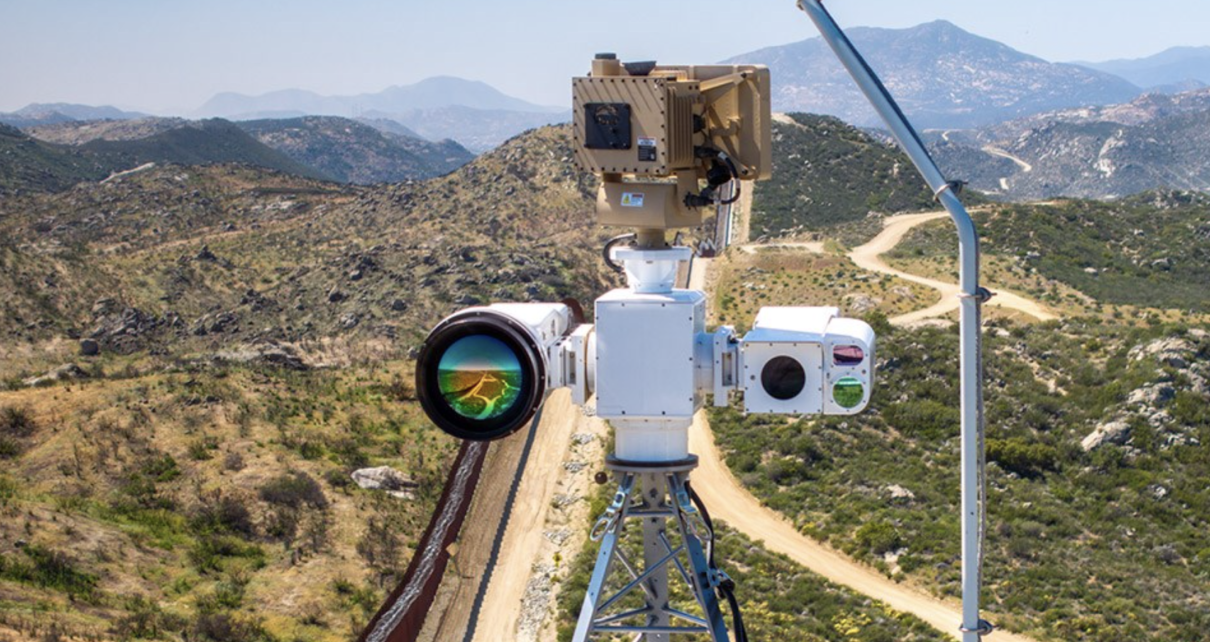
The expansion of autonomous surveillance towers will come at a cost of $1 billion to the American taxpayer, funds that were originally allocated under Trump’s Big Brother Bill.
In June, the Government Accountability Office (GAO) released a new report that detailed how the Department of Homeland Security (DHS) has contracted with Anduril Industries—a Peter Thiel-funded company—to nearly triple the number of surveillance towers along US borders. The report outlines the plan to increase the number of surveillance towers from 830 to 2,300 by 2034.
The new GAO report describes the “Integrated Surveillance Towers” (IST) program that currently consists of “803 fielded towers located along US borders that detect items of interest, such as people or vehicles.”
The IST program includes towers from four legacy systems, including Autonomous Surveillance Towers (AST). An AST is a solar-powered surveillance tower that the DHS says can “provide autonomous surveillance operations 24 hours per day, 365 days per year.” The towers are equipped with radar, optical, and thermal cameras.
According to the GAO report, in August 2024, DHS approved the purchase of up to 42 additional ASTs. DHS had previously approved Customs and Border Protection’s (CBP) request to purchase up to 133 additional towers between 2022 and 2023. The report states that the program should be completed by March 2034, with 2,300 deployed by that date.
The GAO was established in 1921 to serve as an independent and nonpartisan agency that audits the federal government. The GAO releases annual reports on key issues and details its findings to Congress.
The Electronic Frontier Foundation, a non-profit dedicated to digital privacy and rights, called the expansion of border surveillance a “digital dumpster fire for human rights and civil liberties.”
“It’s not just surveillance towers; drones, aerostats, surveillance vehicles, ground sensors, game cameras, and license plate readers are also part of the vast taxpayer-funded infrastructure that threatens all those who live, work, or seek refuge in the borderlands,” the EFF wrote in response to the GAO report. “This technology isn’t exclusive to U.S. federal agencies: it’s also deployed by state and local law enforcement, and even by governments on the Mexican side.”
The EFF also noted that these rapidly expanding surveillance technologies place residential neighborhoods in Arizona within the sight of the towers, making them “capable of spying on homes on both sides of the border.”
Anduril Industries and the Surveillance Lattice
The GAO report notes that the contract for construction of the Autonomous Surveillance Towers went to Anduril Industries.
Anduril was founded by Trump donor Palmer Luckey with funding from Palantir co-founder Peter Thiel. They are one of several Thiel-associated companies that have seen their stars rise under Trump 2.0.
The Last American Vagabond has previously reported how numerous acolytes of Thiel are or were serving in the second Trump administration, including numerous employees of Anduril.
One such example is Trae Stephens, the co-founder and chair of Anduril Industries. According to Bloomberg, Trump and his team have consulted with Trae Stephens. Stephens is a partner at venture capital firm Founders Fund, which was organized by Peter Thiel, Ken Howery, and Luke Nosek in early 2005. Stephens also worked for Thiel’s Palantir Technologies.
In December 2024, Anduril, along with Palantir, SpaceX and OpenAI, announced a partnership on U.S. military contracts. The move marked the latest efforts by the Technocrats to replace the old guard of the Military Industrial Complex—companies like Lockheed Martin, Raytheon, and Boeing.
As part of that effort, Anduril is aiming to be the main provider of Autonomous Surveillance Towers along the border. As far back as July 2020, Anduril was awarded a contract by CBP to set up over 200 mobile surveillance towers in border communities.
The surveillance towers use an Anduril AI software known as Lattice that automatically detects, classifies, and tracks people and vehicles from miles away, during the day and at night. Anduril describes Lattice as a software platform that “takes data from disparate and distributed sensors, feeds, and systems and moves this data into a single integration layer”.
Over the last couple of years, Anduril has secured numerous contracts with the US government to build weapons of war and surveillance tools.
In October 2024, towards the end of the Biden administration, Anduril announced a $249,978,466 contract for more than 500 of their Roadrunner-Ms and “additional Pulsar electronic warfare capabilities.” In 2023, Anduril unveiled their Roadrunner system and their Pulsar family of AI-enabled electronic warfare systems aimed at combating the “growing threat of unmanned aerial systems (UAS),” or drones.
In 2026 alone, Anduril has received at least three contracts with the US government.
In January, the US Marine Corps awarded Anduril a $23.9 million contract to deliver more than 600 Bolt-M systems. In March, Anduril partnered with the US Army to “consolidate the procurement and management of the company’s commercially available technologies.” The ten-year contract has a total estimated value of up to $20 billion.
Anduril signed a contract with the US Air Force for the production phase of the Collaborative Combat Aircraft (CCA) program in June. As part of the arrangement, Anduril will deliver a set of production FQ-44 semi-autonomous fighter aircraft.
Most recently, in July, Anduril celebrated the production of the first Ohio-made YFQ-44A model, an autonomous drone known as the Fury.
Clearly, Anduril’s Military-Industrial-Complex partnership with Palantir, SpaceX and OpenAI is proving quite successful.
Surveillance Funded By Trump’s Big Brother Bill
It’s worth noting that the funding for the Autonomous Surveillance Towers is coming in part from funds allocated by Trump’s controversial 2025 Big Beautiful Bill (BBB), or, more correctly, the Big Brother Bill. (To be perfectly accurate, the funding came from the pockets of American taxpayers, and then was taken by the federal government under duress before being distributed to companies like Anduril.)
The BBB set aside $30 billion for “digital modernization efforts” involving artificial intelligence and biometric surveillance. The bill gave Immigration and Customs Enforcement (ICE) $2.5 billion specifically for AI systems, biometric data collection platforms, and digital case tracking.
Under the heading “U.S. Customs and Border Protection Technology, Vetting Activities, and Other Efforts to Enhance Border Security,” the bill gave $637 million for the “deployment of technology, relating to the biometric entry and exit system under section 7208 of the Intelligence Reform and Terrorism Prevention Act of 2004.”
It will be by air, by land and by sea, according to Trump. So that’s not just immigrants. Welcome to your Freedom MAGA Biometric tracking system: https://t.co/yu4p8mRH0D pic.twitter.com/7vqXDr6JvO
— The Last American Vagabond (@TLAVagabond) January 18, 2025
The section also states that the funds may only be used for “the procurement or deployment of surveillance towers” after they have been tested and accepted by US Border Patrol.
The mention of a biometric entry/exit system and surveillance towers is perfectly in line with the long-term plans of the US government and Donald Trump during his first administration. In fact, I’ve argued since Trump’s election in 2016 that the issue of immigration would be used to divide the masses and help usher in the final stages of the American police state.
These types of technological encroachments—facial recognition, retina scanning—have often been known as a “smart” or “virtual” border wall. The idea is that these technologies can serve the purpose of Trump’s long-promised border wall without the cost of building an actual physical barrier.
The concept was supported by Trump and the Biden administration. In February 2021, I reported that more than 40 privacy, immigrant rights, and civil liberties organizations called on the Biden administration to abandon a bill that would extend the Trump administration’s border policy, particularly the ongoing creation of a biometric wall.
The letter came in response to the US Citizenship Act of 2021, which would direct the DHS to implement new biometric and aerial surveillance technologies at ports of entry and along the US/Mexico border.
While the bill did not become law, the concerns about surveillance along US borders continue. The federal government and courts have consistently ruled in favor of the so-called border search exception that allows search and seizures by agents of the government without a warrant within 100 miles of the border.
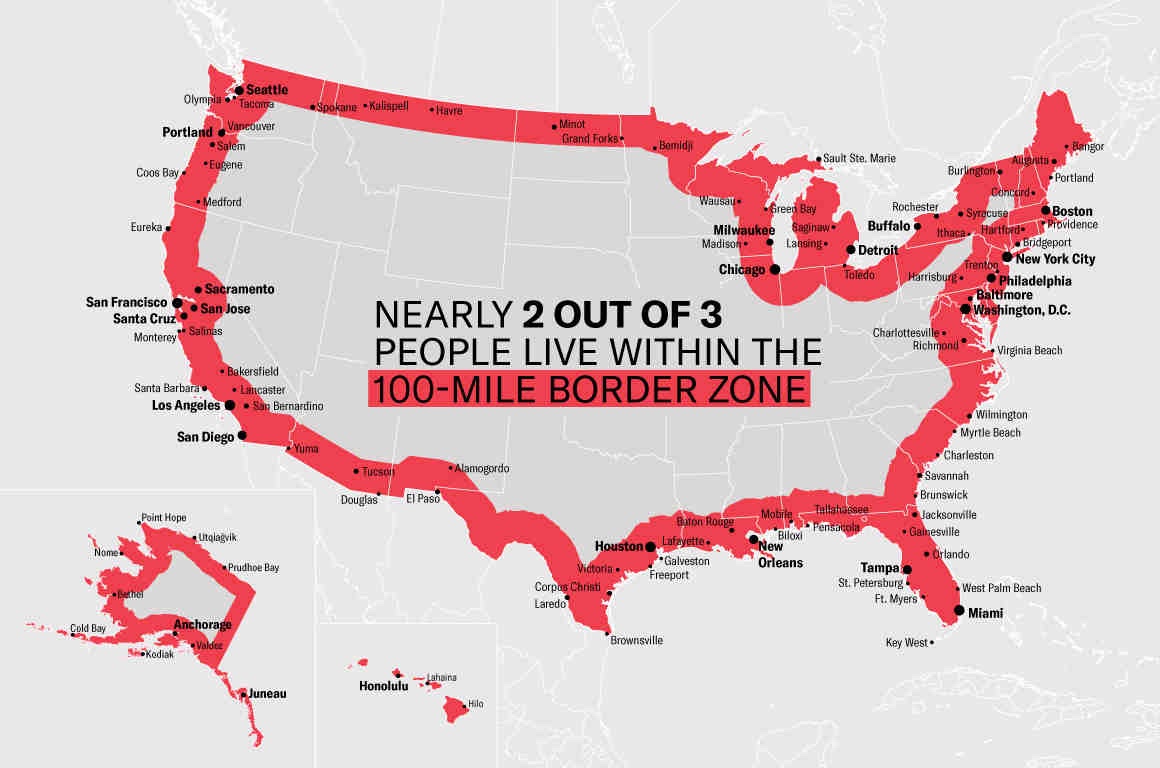
In fact, this belief was just reaffirmed in July when the US Court of Appeals for the Fourth Circuit ruled that manual searches of cell phones at the border are “routine” and thus exempt from the requirement of individualized suspicion under the Fourth Amendment.
However, it is not only along the borders where Americans are subject to surveillance. In 2024, the GAO released a report warning that the DHS and associated federal law enforcement agencies are using more than 20 types of surveillance technologies against the American public without a warrant and with limited privacy protections.
Every year since the attacks of September 11, 2001, Americans have been forced to endure more and more surveillance measures from the federal government, as well as countless state and local law enforcement agencies. As we approach the 25th anniversary of the 9/11 false flag, it’s more important than ever for the American public to ask: are we really free if we no longer have privacy?