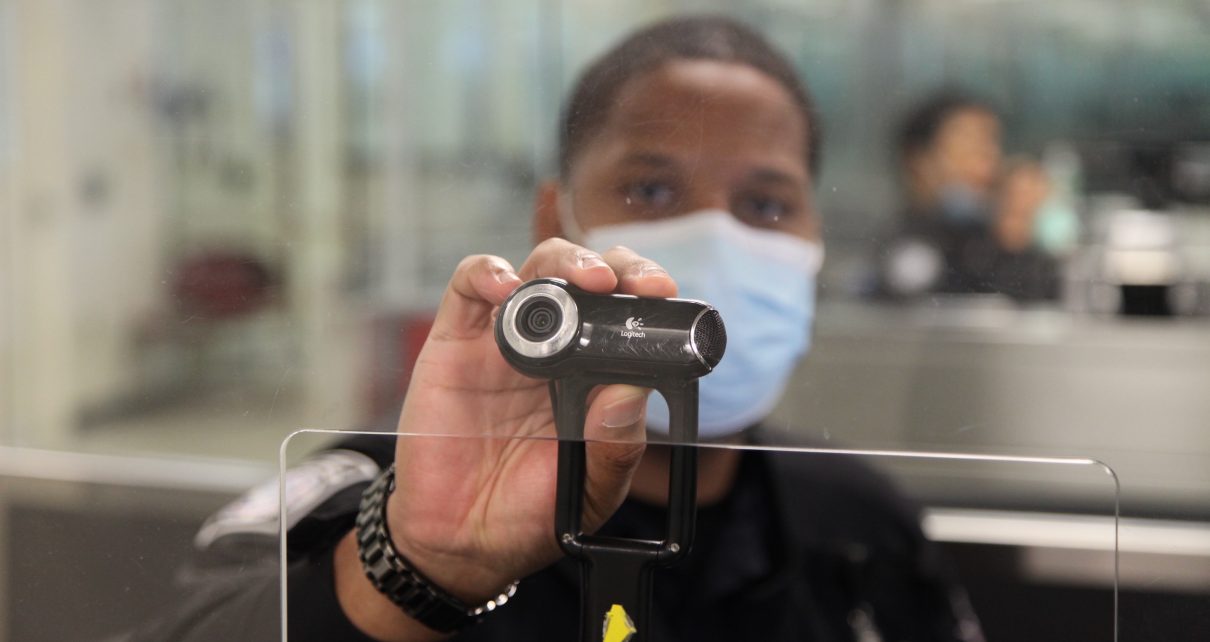
A long-delayed, over-budget biometric program is set to become the largest centralized database of biometric data collected from Americans and foreigners who have visited the United States.
After being troubled by delays and budget concerns for nearly a decade, the Homeland Advanced Recognition Technology (HART) program will become the US government’s largest biometric database when it launches in September. The program has also been plagued by privacy concerns raised by the Government Accountability Office (GAO), which has warned that HART has “gaps” in its privacy policies.
HART will be managed by the Department of Homeland Security (DHS) and will store and process biometric data such as digital fingerprints, iris scans, and faceprints that have been gathered by DHS and its various sub-agencies. According to DHS, government agencies may seek to access this data for national security reasons, law enforcement, immigration and border management, intelligence gathering, background investigations for national security positions, and certain positions of public trust.
While HART is set to complete “initial operating capability” in September 2026, the system is not scheduled to be fully completed until 2027. The system was originally announced in 2015 as a replacement for the legacy Automated Biometric Identification System (IDENT), which was originally developed in 1994 as a law enforcement system for collecting and processing biometric data from individuals apprehended by border security or immigration officials. In 2013, the DHS’ Office of Biometric Identity Management (OBIM) began plans to replace IDENT with HART. HART was set to become operational in December 2018 but was delayed numerous times due to budget concerns.
Since the initial announcement regarding the transition from IDENT to HART, the GAO and digital rights groups have raised concerns about the government upgrading and centralizing its repository of sensitive personal information of millions of Americas.
In February 2020, DHS published its original HART Privacy Impact Assessment to “assess and mitigate any potential privacy risks.” While the system wasn’t yet active, DHS said they “anticipated potential privacy risks associated with the privacy sensitive system” and “sought to proactively develop appropriate privacy safeguards to be implemented” throughout HART’s development.
In September 2023, the GAO released their own report detailing what it saw as “gaps” in privacy policies required by the Office of Management and Budget. The GAO said DHS implemented only five of twelve privacy requirements. GAO noted that the 2020 privacy impact assessment was “missing key information,” including on whose data will be stored in the system and the partners with whom the system will share the data.
The GAO report also said the HART program did not have “assurances that partners that provide information to the system will appropriately retain and dispose of personally identifiable information.” GAO concluded by stating that until DHS addressed these “privacy weaknesses,” there is no assurance that the personal data gathered on hundreds of millions of individuals will be “appropriately protected.”
In August 2024, DHS released an updated Privacy Impact Assessment for HART in an attempt to “clarify and address points raised by external oversight bodies.” The assessment provided answers to some of the questions posed by the 2023 GAO report, namely whose information will be stored and with whom it will be shared.
“HART will contain personally identifiable information, including biometric data and associated biographic information, on U.S. citizens, lawful permanent residents, and foreign nationals,” the assessment stated.
The report says biometric data held in HART may be shared with every agency of the DHS, including Customs and Border Protection (CBP), U.S. Immigration and Customs Enforcement (ICE), U.S. Secret Service (USSS), and the Transportation Security Administration (TSA), as well as other federal agencies such as the State Department, the Department of Justice (DOJ), and the Department of Defense (DOD). It also states that biometric data may be shared with “elements of the Intelligence Community (IC).”
A Surveillance Mosaic
As far back as 2018, digital privacy groups like the Electronic Frontier Foundation have been warning about the dangers posed by HART.
“The records DHS plans to include in HART will chill and deter people from exercising their First Amendment protected rights to speak, assemble, and associate,” the EFF wrote in June 2018. Since that time the organization has submitted numerous comments calling on DHS to “do more to minimize the threats to privacy and civil liberties.”
More recently, in 2025, Calypso Moschochoritis, a law student at The Catholic University of America’s Columbus School of Law, argued that “the current U.S. regulatory scheme is inadequate to prevent violations of privacy rights” that will result from HART’s implementation.
“DHS’s expansive collection of a mosaic of data will lead to increased surveillance in all spheres of human life,” she wrote.
“HART will allow DHS to pair intrusive biometric technologies, thus allowing the government to observe and record an individual’s identity at a distance, in public places, and in an ongoing manner… With its potential to reveal a person’s constant movements, HART creates a risky mosaic of an individual’s life.”
Immigrant rights organizations also opposed the launch of HART based on their belief that it will increase the federal government’s ability to target individuals suspected of immigration violations. In 2022, the Immigrant Defense Project released the “HART Attack” report outlining how the database would “turbocharge DHS’ unchecked power.”
The fears of DHS gaining unchecked power have grown under the second Trump administration as ICE has been found using smartphones equipped with an internal app called Mobile Fortify to scan the faces of suspects. In July 2025, 404 Media reported that “ICE officers are able to point their smartphone’s camera at a person and near instantaneously run their face against a bank of 200 million images, then pull up their name, date of birth, nationality, unique identifiers such as their ‘alien’ number, and whether an immigration judge has determined they should be deported from the country.”
404 Media called the app an “unprecedented linking of government databases into a single tool, including from the State Department, Customs and Border Protection (CBP), the FBI, and state records.” It is highly likely that such technological tools will soon be linked to the HART database.
As the US government seeks more technologically advanced tools to prevent illegal immigration and combat alleged terrorism, the public is likely to see an increased push for funding of devices capable of collecting biometric data that will later be stored in HART. According to the Brennan Center for Justice (emphasis added):
“Spending on biometrics has far outstripped the other identified categories in recent years, with more than $1 billion spent or promised. This spending is driven by three types of contracts: the expansion and maintenance of DHS’s massive biometrics database through contracts with General Dynamics, Peraton, and Science Applications International; the collection of biometric and biographical data from applicants for immigration-related services, via contracts with Amentum and Pluribus Digital; and new tools for mobile biometric matching from NEC Corporation, which created Mobile Fortify, and BI2 Technologies, provider of iris recognition. Combined, these contracts undergird DHS’s ability to identify individuals by their biometric identifiers, with agents in the field gaining access to this capability and reportedly turning it on protesters and observers.”
The Brennan Center also notes that while the Mobile Fortify app used by ICE is currently “intended to be used to identify undocumented persons who are eligible for removal,” the technology can ultimately be used for anyone, including American citizens.
This fear is worth considering, especially in light of the fact that the Trump administration is currently rolling out Autonomous Surveillance Towers along the border, the rapid expansion of automatic license plate readers from Flock and Axon, and the increase in facial recognition cameras.
Remember, while walls—whether they are physical or biometric—can be built to keep unwanted people out, they can also be built to trap people in.