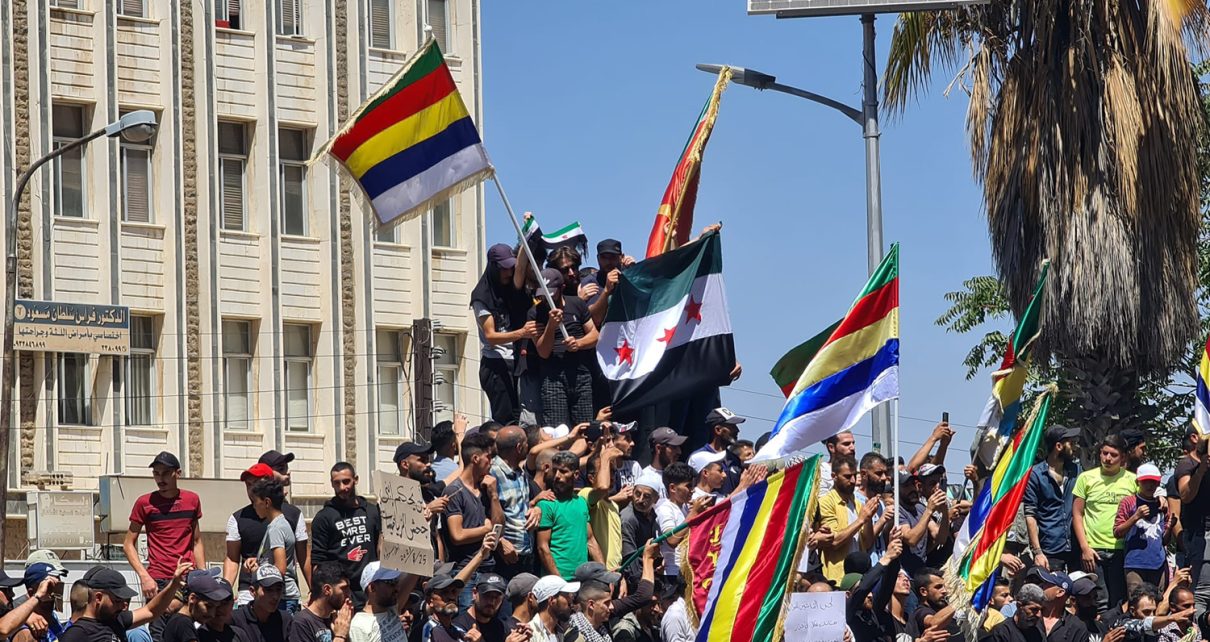
On August 20, protests erupted in the Druze-majority Syrian city of Suwayda over a decision from the Damascus government to cut subsidies for basic items such as fuel. As strike action continues, along with popular non-violent protests, fears again emerge that the situation could quickly turn violent and that the Syrian war could once again ignite.
Demonstrations in as many as 40 separate locations have taken place in Syria’s as-Suwayda Governorate, since late August. The events we are now seeing mirror similar protests that started on February 7, 2022, which eventually petered out, but were not free of violent confrontation. Since last year, however, the situation inside Syria has only deteriorated, with the specific issue of Suwayda proving to be a multi-faceted challenge to the Syrian government in Damascus. As usual, Western media are promoting the idea of a liberal women-led rebellion against Bashar al-Assad’s rule, attempting to re-kindle the unresolved war that began in 2011.
Suwayda, home to many of Syria’s Druze minority community, had been largely on the side of the Syrian government during the course of the devastating war, or chose to simply remain neutral. In fact, Damascus managed to integrate various local militias inside their own security force apparatus. This had meant that for the Syrian government and its allies, the Druze majority area did not require the direct control of the Syrian Arab Army (SAA), in the way that various other cities did once they had fallen back under government control.
When we look at today’s unrest in Suwayda, the initial spark to the current round of demonstrations may have been the slashing of subsidies by the Syrian government, yet there are now a multitude of issues that are to be addressed in order for a long-term solution to set in. The top consideration from the average citizen, which heavily influences their sentiment towards the State, is their socio-economic position. Although there are certainly steps that Damascus can take to create some kind of calm, the nation is suffering under some of the harshest sanctions ever known to man.
According to UN Special Rapporteur on unilateral coercive measures and human rights, Alena Douhan, Western nations imposing sanctions on Syria should drop them immediately. Following a fact finding mission to the country, Douhan reported that he was,
“struck by the pervasiveness of the human rights and humanitarian impact of the unilateral coercive measures imposed on Syria and the total economic and financial isolation of a country whose people are struggling to rebuild a life with dignity, following the decade-long war.”
On top of this, in the lead up to Syria’s re-integration into the Arab League earlier this year, Damascus had agreed to take measures in order to stop drug trafficking across both the Iraqi and Jordanian borders. Steps taken by the Syrian government to tackle the illicit drug trade (evolving around the Captagon drug) meant that gangs in Suwayda were cracked down upon and this created tension. Unfortunately, Syria is currently plagued by a myriad of criminal networks throughout the country, which pose serious issues to the nation’s security, this problem has grown out of control in the years following the imposition of the US’ Caesar Act sanctions.
A statement signed by two of the Druze community’s three highest leaders, called for “a governmental change and the formation of a new government capable of managing the crisis, improving the situation, finding solutions and not off-loading responsibilities.” Despite this, Druze leaders, such as Sheikh Al-Aql Youssef Jarbou, have taken the side of Damascus and prominent leaders have not called for the ousting of President Bashar al-Assad.
For foreign actors, and the plethora of armed militant groups in Syria backed by them, the events transpiring inside Suwayda are an opportunity to stir chaos, seize territory, and re-kindle the flames of war. For instance, the Kurdish-led Syrian Democratic Forces (SDF) which work as the US proxy, that helps maintain their illegal occupation of a third of Syrian territory in the North East, have offered their explicit support for not only the Suwayda protest movement, but have encouraged Druze independence. Worryingly, elements of the Suwayda protest movement are actually verbalizing the idea of protecting the security of Southern Syria, which in rhetoric is being detached from the situation in Damascus and the rest of the country.
During the last round of protests in 2022, the al-Qaeda affiliated Hayat Tahrir al-Sham — which controls much of the Idlib area in the North West of Syria — also jumped to encourage a Syrian revolt, and this time around terrorists from Idlib have utilized the moment to launch a number of offensive actions against the Syrian Arab Army (SAA) also. According to a security source speaking with The Last American Vagabond, who chose to remain anonymous, despite Syria having been re-introduced into the Arab League, finances are still continuing to be sent to anti-Assad militant groups in Syria from Qatar. The source did not specify which groups were being financed, nor would the source elaborate to confirm whether the financing of groups extended beyond the Idlib Governorate.
On July 7, 2021, the Syrian opposition announced the formation of the Syrian al-Liwa Party, which vowed to protect Suwayda from the “terrorism of the Syrian government” and clearly presented itself as a sectarian Druze party, which has been linked to the Lebanese Druze leader, Walid Jumblatt, who opposes Syrian President Bashar al-Assad. The Syrian al-Liwa Party is also connected to a militia group known as the ‘Counter-Terrorism Force’, which states that “The main mission of the new military entity, made up of members of the Druze community in the area, is to fight terrorist gangs, especially those who hold [regime ID] cards issued by the regime and carry out terrorist acts against civilians in Suwayda, including kidnappings and killings. The force aims to curb the regime’s facilitation of Iranian militias, most notably Lebanese Hezbollah.”
Walid Jumblatt was recently interviewed on what he thought about the ongoing tensions in Suwayda with the Druze community there, to which he responded by saying “I have not heard of a plan linked to Syria and Iraq, and the demands of the people of Suwayda are the demands of all the Syrian people, which began in 2011 and are the same demands as nothing has changed,” stating that anything else being stated about events there are tantamount to fact-free conspiracy theories.
The leader of the Syrian al-Liwa Party is a man named Malek Abu Kheer, who, according to Nowras Aziz, “contacted the [US-led international] coalition forces at Al-Tanf base in the second half of 2020, explaining his plan in Suwayda. Abu Kheer had informed the forces that the steps would include declaring full control over the eastern villages [of Suwayda province] and removing any presence of the Syrian regime or Iran in that area.” Iran is notably not operating any proxy forces in Suwayda and the motives of this group, having allegedly made contact with an illegally occupying power in Syria [the US], are questionable to say the least.
Amidst all of this chaos, the position of Israel has been undisclosed publicly and so far there have not been any Israeli airstrikes on Syrian targets since around a week prior to the start of the protests in Suwayda. This, however, does not in anyway dispel the possibility that Tel Aviv is actively working towards a strategy to back calls for a “Druze self-administration”, which would be tantamount to a “federalization of southern Syria”. In 2022, the Israeli regime sent the spiritual head of the Druze community in occupied Palestine, Mowaffaq Tarif, to present its demands of federalization to Moscow.
The Druze community that lives within the borders of Palestine, which is controlled today by the Israeli occupation, are starkly different to their fellow Druze in Syria, including inside the occupied Golan Heights. The Palestinian Druze, who today call themselves Israelis, are completely on the side of the regime in Tel Aviv, while the Syrian Druze have historically taken the side of the Syrian government. However, Israel knows that they still can attempt to utilize their ties to the Druze in Palestine and even in Lebanon, in order to stir chaos inside Syria, something that has so far proven to be a failure.
Since the beginning of the war in 2011, the goal of those backing the ousting of Bashar al-Assad was to Balkanize Syria and create small autonomously governed entities that would be divided by sect and religion. The Israelis would benefit the most in the region from this, as this not only would pave the way to them capturing and occupying more Syrian territory, but would provide the perfect excuse to their own State model. Israel brands itself as the “Jewish State” and has adopted legislation that asserts the supremacy of Jews over all other peoples living under their control, this is something that is only currently mirrored by the various Kurdish movements in the region — although with various differences.
Tel Aviv has long presented its plans for an extended buffer-zone to be agreed upon, which would separate it from Syria and enable it to occupy more territory in Southern Syria. Israel cannot openly be the champion of a Druze independence movement at this time, as the Druze inside Syria are very much opposed to it, yet it does act to try and achieve this goal where it can. If a movement emerges in Suwayda, which demands federalization, whether this be led by gangsters and militias, or some of the community leaders, there can be no doubt that this will serve the interests of the Israelis. In addition to this, this will also serve the agenda of the United States inside Syria as well, which is desperately attempting to push its own model for ending the war officially.