Millions of Mexican citizens have had their phone lines disconnected after refusing to register their identities with phone companies.
The Mexican government and Mexican telecommunications companies have disconnected millions of phone lines belonging to citizens who failed to register their phones with their identities. The move comes just two months after the government announced a delay in the registration deadline due to less than half of the country complying.
In early September, Mexico’s Telecommunications Regulatory Commission (CRT) released a statement claiming that about 9.55 million phone numbers ending in “1” were registered. The CRT said about 1.9 million had been temporarily deactivated for failing to register on time. The agency claimed more than 1.16 million were reactivated after registration.
In June, the CRT announced a staggered extension for citizens to register their mobile phone lines with their identification. The new deadlines were based on the final digit of the phone number, with phone numbers ending in “0” given until August 15 to comply, numbers ending in “1” given until September 1, and so on until December 31.
While announcing the numbers for September 1 registration, the CRT reiterated its claimed purpose for linking phone numbers to individual identities, stating:
“This link seeks to eliminate anonymity on mobile lines to contribute to the fight against crimes committed through cell phones, such as fraud and extortion.”
However, since the cancellation of phone lines has begun, Mexican citizens have been posting on social media detailing their skepticism. They are increasingly concerned about how their data might be stored and who might have access to it.
These concerns are particularly prescient after numerous hacks of Mexican government databases, including one in late 2025 in which hackers used Claude AI to gain access to private information. As one user wrote:
“I’m really upset: because they didn’t register my line, they suspended my service and I was left without data. I paid for the phone, I pay the balance, and the service too. Why do I have to give more personal information just to use it? More citizen info doesn’t mean more security.”
Some users said they had registered in time, but were still disconnected.
“They suspended my line, my deadline hasn’t passed yet, the app says my line is already registered… and then what? I’ve been waiting for over two hours for a turn in the chat and on the phone and nothing, just a bot”
Me suspendieron la línea, aun no pasa mi fecha limite, en la app dice que ya esta registrada mi linea a mi CURP… y luego? llevo mas de dos horas esperando turno en el chat y en el teléfono y nada, puro bot. Donde quedó la atencion personalizada que tenían. Exijo respuesta
— Cuervobrí_13💜 (@Cuervobri_) September 15, 2026
This requirement to link a person’s ID with their phone line is a fairly new development in Mexico—one of the few places in the world where individuals could still purchase and use SIM cards in cellphones without registering a name or showing some form of identification.
While many phone users in Mexico have already shared personally identifying information when signing up for their service, many activists, journalists, domestic violence victims, and those seeking anonymity have relied on prepaid anonymous SIM cards. Legislation passed in July 2025 changed this by requiring phone users to register their phone line with proof of identity before June 30, 2026, or face interruption of service.
The Mexican government has claimed the laws will combat organized crime and drug trafficking and aid in the search for missing people. Critics, however, worry that the new laws will increase opportunities for government surveillance.
Mexicans Attempt to Evade Registration
On the eve of the deadline for Mexicans with a number ending in “2,” the media outlet Excelsior released an article detailing how some citizens are using eSIMs, or digital SIMs, that allow users to continue to operate their phones. While the eSIMs do not work perfectly with apps that require SMS text verification, such as WhatsApp, they do allow users to continue using a phone with data so they can access the internet.
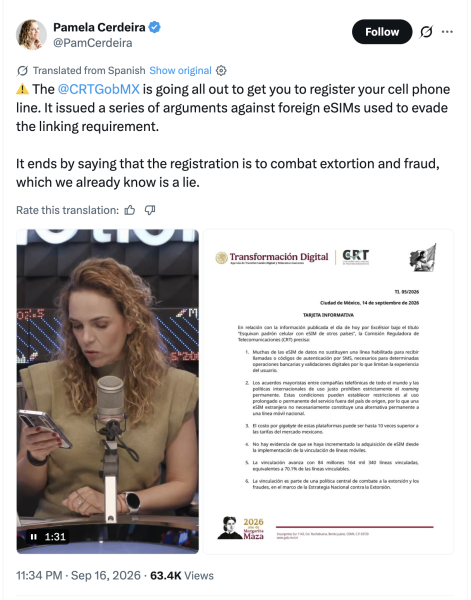
In response to the article, the Mexican government issued a press release attempting to discourage the use of eSIMs. The CRT noted that telephone companies have policies prohibiting “permanent roaming” that may prevent users from using foreign SIM cards to operate in Mexico. The CRT also claimed that using eSIM platforms can cost “up to 10 times higher than Mexican market rates.”
“The CRT urges the population not to fall into deceptions of offers on social networks or websites that promise to avoid linking,” the statement concluded.
Journalist Pamela Cerdeira responded to the CRT statement and to claims that phone registration would stop criminal extortion, calling the scheme a “lie.”
In addition to eSIMs, some Mexican citizens have attempted to register their phone lines with fake images of faces created with AI. One tweet shows a user attempting to scan the face of a statue of a saint. The tweet has been seen more than 400,000 times.
Ya estamos registrando nuestra línea telefónica 🫰🏻🫢 pic.twitter.com/epgo17t3G9
— 🎙️ ᗰᖇ. ᑕíᐯIᑕO ®🇲🇽₿ ✖️ (@MrCivico_) September 16, 2026
It is clear that efforts to force Mexicans to register their identities with their phone lines, and rolling out biometric identity, are aimed at eliminating privacy and individual sovereignty for the Mexican people.