
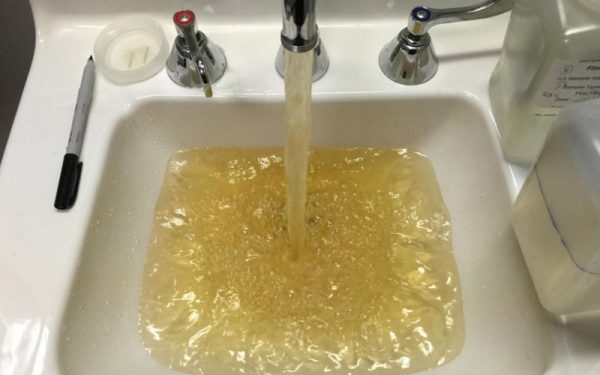
It is the hottest story in 2016 so far: hundreds of people have been poisoned for as long as a year and a half by a neurotoxin released in large quantities directly into their water supplies. Cable news and papers across the country have covered the emergency with horrifying interviews, wild statistics and the repeated account of how all this came to be.
Flint, Michigan. It has become one of the starkest examples of how political administrative failures can suck the very life out of a helpless community. But, why is Flint getting so much attention? Currently, across America there are numerous examples of water contamination crisis of comparable severity to Flint, Michigan’s. From Appalachia to the Navajo Nation, communities are struggling to maintain themselves on a supply of dangerously toxic water. Some of these disasters are new, some are old, some can be blamed solely on the government, while others have a lot of players pulling strings from suspicious angles … But there’s one unnerving commonality between these cases that ties them all together.
 Let’s start with what is already well-known – residents in Flint have been consuming, cooking with, and bathing in neurotoxic water for months. In the poorest parts of town, it has been close to a year and a half. The people of Flint are commonly ailing from stomach problems, painful rashes, and loss of hair because of the amount of toxins they are being poisoned with. In April of 2014, the city switched its water supply from Lake Huron to the highly corrosive and filthy backwaters of the Flint River in an effort to save themselves money (roughly $100 per month). Needless to say, this backfired. The water from the Flint River ate through the city’s lead plumbing, came out of taps reeking of sulfur and chlorine, discolored and full of particulate matter. The Michigan Department of Environmental Quality is grievously responsible for mishandling and inadequately testing the city water supply – basically, they dropped the ball really hard. And the underprivileged, poor, and largely black members of this community are suffering horrible health effects as a result. This mistake will cost the city roughly $1.5 billion to resolve the problem … Which, on a $100 per month payment plan, could be resolved in a mere 1,250,000 years.
Some 500 miles to the south of Flint, Michigan is a swathe of Appalachia that was once happily and easily inhabited. Lindytown, West Virginia was a modest, low-income town that has since been rendered almost wholly inhospitable by toxic air and water quality. The town is a specter of what it once was – empty houses line the empty streets with empty driveways and empty windows; churches are boarded up and schools evacuated. Complimenting the desolate nature of this ghost town are the distant explosions that punctuate the strange silence. Powerful energy companies like Patriot Coal have been highly involved with mountain top removal mining in the area for several years – this wickedly intrusive method of coal extraction literally blasts the top off mountains, laying bare the rich coal seams that lay beneath. It is easier and much cheaper than it would be to extract the coal through less violent means. Roughly 800 feet is sheared off of every mountain they choose as a victim. The explosive chemicals mix with the dust and ash and coal following the detonations, making the air difficult to breathe and the water toxic to drink. Arsenic, lead, mercury, magnesium and selenium are leaching into lakes, streams and groundwater to catastrophic effects: higher levels of lung, heart, and kidney disease mortality, and birth defects are expected amongst the impoverished residents of Lindytown … A grim fate to be facing. But the coal companies aren’t concerned in the slightest, and since no government action has been taken to penalize the energy company for its actions, it is fair to assume the government isn’t too concerned either.
Last year near the town of Durango, Colorado a disastrous leak sprung from the side of a gold mine, staining the San Juan and Animas rivers a fluorescent and altogether unnatural shade of orange. It was an environmental catastrophe, wholly attributable to the Environmental Protection Agency, who broke through a rock dam at the mine, which weakened the structure and caused 3 million gallons of lead and arsenic infused water to gush brutally from a mountainside and into the Animas. Of course, the people of Durango and Silverton suffered from this devastation, but the real victims (besides the aquatic animals that died) were downstream in New Mexico. Farmers who used the Animas for irrigation endured loss of crops because they had no clean water to use for farming. Then, the weird orange plume traveled even further downstream straight into one of the most exploited demographics in America…
 The Navajo Nation covers much of the Four Corners area, and for years they have been the victims of senseless, unethical pollution at the hands of energy companies and the United States Government. Coal mining, power pants, uranium mines, and uranium spills plague the residents of this region. Coal fired power plants and radiation from cold war uranium spills and radioactive tailings have poisoned nearly all of the natural water sources in this region. This type of extensive pollution and corporate exploitation has been going on for years. Then, on August 10th 2015, the Tribal Officials of the Navajo Nation were forced to declare a state of emergency because the horror of the Animas river disaster had finally reached them. This was just another slap in the face to this underprivileged, impoverished, relentlessly abused corner of America. This travesty has largely been ignored by the media and US government, despite the severe implications and widespread nature.
So we know that water contamination in the United States isn’t too uncommon. It happens, unfortunately. The circumstances aren’t always the same, but there is a pattern: those who suffer the most from a serious case of contaminated water, are typically low-income, minority groups that cannot defend themselves. Either the government or powerful private interests try to minimize their costs of operation at the expense of those without a voice. There is a serious lack of justice exposed by these cases, and it’s doubtful that any kind of fair atonement will follow up. While Flint’s crisis is nothing to downplay, it’s just one example of a system of exploitation and negligence that is suffused throughout America – a system that is poisoning us from within.
Sources: http://bsnorrell.blogspot.ca/2016/01/navajo-water-contamination-more.html?spref=fb, http://content.time.com/time/health/article/0,8599,1971709,00.html, http://fivethirtyeight.com/features/what-went-wrong-in-flint-water-crisis-michigan/, http://www.usatoday.com/story/news/nation-now/2016/01/19/michigan-flint-water-contamination/78996052/, http://www.cnn.com/2016/01/26/us/flint-michigan-water-crisis-race-poverty/index.html, http://krqe.com/2015/08/10/governor-martinez-declares-state-of-emergency-after-animas-river-spill/, http://krqe.com/story-map-a-walk-through-the-animas-river-spill/, http://www.denverpost.com/environment/ci_28647978/colorado-faces-230-mines-leaking-heavy-metals-into





3 Replies to “Poison Below the Poverty Line – An American Water Crisis”