

Earlier this week, I shared a tweet entitled “8 Ways To Take Down Flock Without A Sawzall.” It was a follow-up to a viral FOIA thread I posted on X earlier in the year, giving people a template file for a records request about Flock cameras in their own communities. (If you’re interested, you can find it here.)
But filing a FOIA request is only one tool.
There are many other ways ordinary people can legally challenge the expansion of automated license plate reader systems. Knowledge without strategy changes very little. But when informed people act with purpose, even the most entrenched systems can be challenged.
Personally, I think we’re well beyond the denial stage. The surveillance state isn’t coming—it’s already here. Because of that, I don’t spend much time judging how other people choose to push back. Some people protest. Some organize. Some file lawsuits. Some file public records requests. Some use Sawzalls.
This article isn’t about any of that.
This is for the people who want to use lawful, public channels to challenge Flock’s expansion in their own communities.
Will it take longer? Usually.
But it also tends to have a much longer shelf life. Cameras that are physically removed are often replaced within a few days, usually at the expense of the taxpayer. However, cameras that lose funding, contracts, or public support often stay gone for good.
I should also mention that part of what motivated me to put this list together was a recent interaction I had with Flock’s CEO, Garrett Langley.
I asked him a sincere question on X. Flock says “safety is a fundamental right,” so I asked, “But what if the company is actually building one of the largest surveillance infrastructures ever deployed in American neighborhoods? What if this technology slowly transforms our cities into a digital architecture of control rather than simply making them safer?” Instead of answering, he blocked me.
Silence isn’t an answer, especially from someone whose company asks the public to trust a surveillance network spanning thousands of communities. So, if those answers aren’t coming from Flock, then it’s up to us to start asking the questions ourselves.
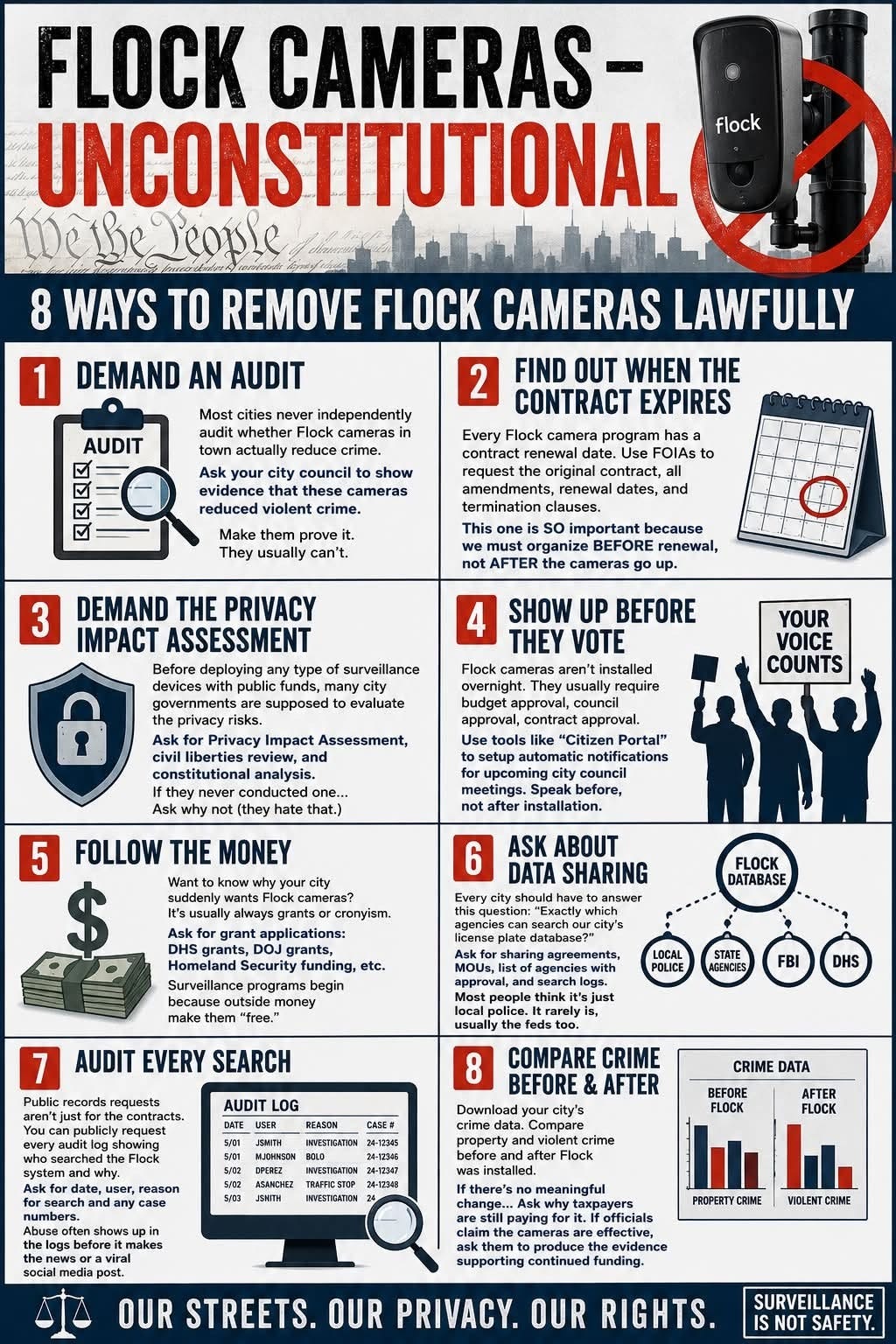
Here are eight ways to do exactly that.
1. Ask Your City to Prove Flock Works
One of the simplest questions is often the hardest for officials to answer.
Has Flock actually reduced violent crime?
Not crime somewhere else.
Not what the company claims.
Your town.
Many cities renew surveillance contracts year after year without ever conducting an independent review of whether the cameras accomplished what they promised.
Ask city council members for the evidence. Ask for reports. Ask for crime data. Ask whether anyone ever evaluated whether taxpayers are getting what they paid for.
You might be surprised how often nobody has.
2. Find the Contract Before Renewal
Timing matters.
Most people don’t learn about Flock until the cameras are already installed.
By then, the fight becomes much harder.
Every contract has an expiration date. File a public records request asking for the original agreement, any amendments, renewal dates, and termination clauses.
Knowing when that contract expires gives your community time to organize before another vote takes place instead of scrambling afterward.
3. Ask for the Privacy Review
When governments spend public money on surveillance technology, they should be asking more than one question:
Does it work?
They should also ask:
What does it do to privacy?
What are the risks?
How is the data protected?
Were civil liberties considered?
Ask your city whether a Privacy Impact Assessment or similar constitutional review was ever conducted.
If the answer is no, ask why not.
4. Show Up Before the Decision Is Made
Most surveillance systems don’t appear overnight.
They usually go through committee meetings, budget discussions, contract approvals, and council votes.
Those meetings are public.
Many cities also let residents subscribe to meeting notifications so you know when surveillance contracts appear on an agenda.
Showing up before the vote is almost always more effective than protesting afterward.
5. Follow the Money
Surveillance often expands because someone else offers to pay for it.
Federal grants from agencies like DHS or the Department of Justice can make expensive surveillance systems look “free” to local governments.
Of course, taxpayers still pay.
Ask your city whether outside grants funded the purchase.
Request grant applications, award letters, and communications related to funding.
Money usually tells the story.
6. Ask Who Can Search the Database
Many people assume only their local police department can access Flock.
That’s rarely the whole picture.
Ask which agencies have permission to search your city’s license plate database.
Request memorandums of understanding, data-sharing agreements, participating agencies, and any policies governing outside access.
People deserve to know who can access information collected in their own neighborhoods.
7. Request the Audit Logs
Flock records searches.
That means there is often a record showing who searched the system, when they searched it, and sometimes why.
Those logs can reveal misuse long before it becomes a news story.
Request audit logs, dates, users, reasons for searches, and associated case numbers whenever possible.
Transparency discourages abuse.
8. Compare Crime Before and After
If officials claim the cameras are working, ask them to show you.
Many cities publish crime statistics online.
Compare crime before installation and after installation.
If there’s a measurable improvement, great.
If there isn’t, taxpayers deserve to know why they’re still funding the program.
Claims should be backed by evidence, not marketing.
Helpful Tools
Fortunately, you don’t have to start from scratch. Several excellent tools already exist to help map Flock cameras, research contracts, file public records requests, and better understand the expanding surveillance network. Here are five of the best:
DontGetFlocked.com lets you enter a starting point and destination, then estimates how many Flock cameras you’ll encounter while suggesting routes that reduce your exposure.
EyesOnFlock.com is a crowdsourced project tracking camera locations, contracts, and deployments around the country.
Deflock.me maintains a nationwide map showing Flock deployments, removals, and community resistance efforts.
HaveIBeenFlocked.com allows users to quickly check whether Flock cameras operate in their area and what information may be collected.
ALPR.wtf maintains one of the most comprehensive databases of automated license plate reader deployments in the country, including guidance for submitting public records requests.
Each offers a different piece of the puzzle, whether it’s locating cameras, reviewing contracts, avoiding surveillance routes, or learning how to file records requests.
The Road Ahead
Ultimately, this conversation isn’t really about cameras or surveillance. It’s about what kind of society we want to leave behind for future generations. If constant automated surveillance becomes the norm for today’s children, what will seem ordinary to the next generation?
The most effective surveillance systems don’t succeed because people are forced to accept them. They succeed when people eventually stop noticing them.
That’s why this conversation matters now, not five years from now.
That future isn’t inevitable.
Communities still have a voice. Contracts can be challenged. Public officials can be questioned. Policies can be changed.
History is full of ordinary people who decided enough was enough.
There’s no reason this can’t be one of those moments too





No thanks, I will be destroying every flock camera physically before I “follow the money” People dont have time for that, but they do have time for simple destruction of a problem. I have personalyl taken down about 12 so far, and I plan of destroying more. If any type of law comes after me, I will be killing them, not going to jail. Thats for damn sure.
As I have said before, I think these things are unconstitutional and should be taken down. But if your goal is to make the rest of us look unhinged and violent, you are in the wrong place. We NEVER advocate for violence. Why anyone would publicly state something like this (about killing) comes down to two possibilities in my mind. One, you are mentally struggling, and I hope you do not act in violence or take any action you will regret. Two, you are here to create the impression that efforts like ours are not legitimate, not non-violent, and not constitutionally protected, but instead that we are all violent, irrational “conspiracy theorists”. If the latter, again, simply won’t work here.
I agree with Max Albert, bar the killing of thugs in uniform.
Please tell me, Ryan, how many times have you done what Jason advise in his articles and did it work?
The advice given by Jason are great for someone who has a lot of time to waste, a lot of money and good lawyers. Most people won’t do that because they neither have time, money and skills to do so.
I have tried to reason with so-called ‘authorities’, the bureaucrats, you lose 90% of the time and you waste a lot of precious time.
In the UK they tried the 15mn city cameras and it didn’t work because activists simply removed barriers and destroyed cameras. These people are heroes.
The people always preaching non-violence are most of time controlled opposition. The scumbags in power who abuse our rights and the constitution laugh at your non violent protests, requests and petitions. The only thing they fear is a united people being violent enough to go after them.
The solution is to sabotage the control grid infrastructure which doesn’t avoid rich people and lawyers to fight it with other means.
Thank you Max Albert, you are a hero.
Just don’t get caught.
“How many times have you done what Jason advise in his articles and did it work?” Countless times. And I am sure you know that. Many failed as well. But I think you need to look at the assumption (an incorrect one) that is guiding your comment here. This post was made as a way to show alternative paths to stopping Flock, through the system. It is made for those who do not agree with other types of action. It is also interestingly made for those doing the exact same thing you are doing here but in reverse. They argue that only highlighting violent action (which they suggest is what we do because we are controlled opposition of course) is a set up. Which we obviously don’t do, but they see one comment or one title and assume. But for those who have done their due diligence, they know there is far more nuance. We need both types of action, while being open to others, if we are truly seeking change. Violence begets violence, and we are living through that. You might want to think about it.